



 SCHEDULE SERVICE
  CALL 972-346-2332
 TL;DR
A water heater expansion tank absorbs the extra volume created when cold water is heated in a sealed plumbing system. Roughly forty gallons of water heated from street temperature to a normal thermostat setting gains about half a gallon of volume. On an open system, that surplus drifts back out to the city main.
Where a check valve, backflow preventer, or pressure-reducing valve sits on the service line, the system is closed, the surplus has no exit, and pressure climbs every time the burner runs. The tank holds a cushion of compressed air behind a rubber bladder, so the surplus water pushes into the tank rather than against the relief valve, the faucet seats, and the seams of the heater itself.
What Makes a Home Plumbing System Closed?
A home becomes a closed system the moment a one-way device goes on the water service. Texas regulators put it in plain language. Their guide for public water systems says a closed system “is created when an approved backflow prevention assembly or a check valve (which is not approved for backflow prevention) is installed at a customer’s service connection,” and that such devices “eliminate a path for expanded water to flow back to the distribution system, resulting in increased system pressure.”
The same state guide lists what that pressure does downstream: pressure surges, dripping faucets, chronic or continuous dripping of temperature and pressure relief valves on water heating tanks, and other mechanical problems with those tanks including distortion and rupture. That list is worth reading twice. It comes from TCEQ publication RG-206, revised January 2020, not from a plumbing sales brochure.
Most homeowners never get told any of this.
The state guide asks water suppliers to notify customers when a closed system has been created and to hand over information about thermal expansion. That notice tends to arrive as one line buried in a utility packet, if it arrives at all.
Where the one-way device usually sits
On the newer subdivisions we work in, the device is almost always a pressure-reducing valve at or just past the meter, sitting in a box near the front flower bed. Modern residential PRVs carry an internal check, so the valve that tames your street pressure also seals your house off from the main. Irrigation backflow assemblies sit on the sprinkler branch and do not close the house, which trips up a lot of otherwise sensible internet advice.
What Does the Tank Actually Do When the Burner Fires?
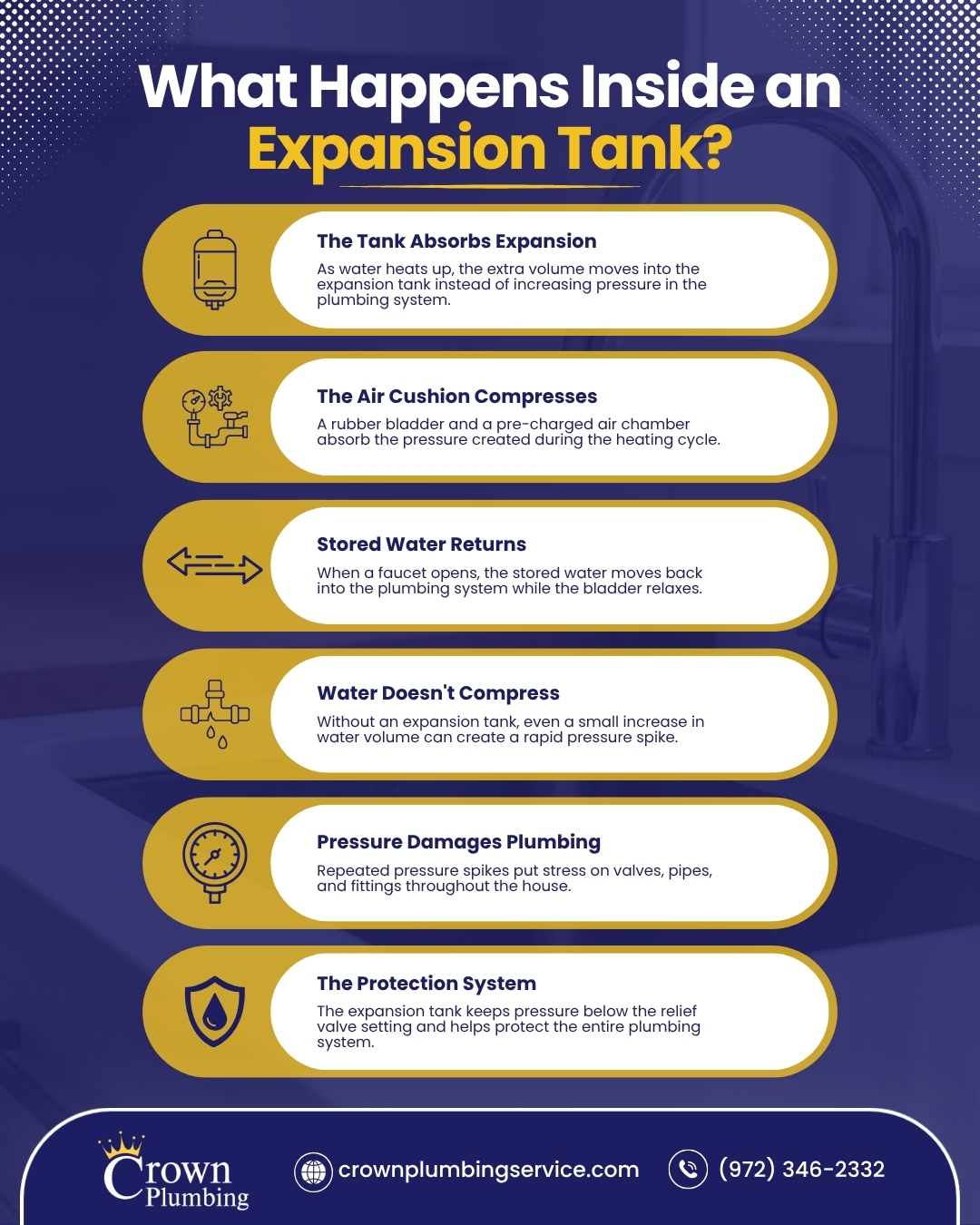
Inside the tank is a rubber bladder with compressed air behind it. When the burner or element heats the water and the volume grows, that surplus pushes into the tank, squeezes the air cushion smaller, and system pressure barely moves. Open a tap, draw water off, and the air pushes the stored water back into the line while the bladder relaxes. It breathes, in and out, several times a day, for years, with no moving parts and nothing to service.
Without the cushion, water has nowhere to yield.
Water is close to incompressible, so a small increase in volume inside a rigid pipe turns into a large jump in pressure very quickly. A house sitting at a comfortable 65 psi can spike well past its relief valve setting during one heating cycle, hold there for a few minutes, then fall back the moment somebody flushes a toilet. Nothing dramatic happens on any single cycle, and that is exactly why the problem goes unnoticed for years.
The damage is cumulative, spread across every fitting in the house, and it never announces itself with a bang.
Amtrol’s own installation instructions describe the working end of it: expanded water enters the tank’s reservoir and the pre-charged air chamber absorbs the increase, “keeping system pressures below the relief valve setting.” Same document, same page, tells the installer where the tank belongs, which we will get to shortly.
The Code Language Behind the Requirement
Two short code sections drive everything a plumber does here. Section P2903.4 of the International Residential Code, the residential code family North Texas towns build under, states that “a means for controlling increased pressure caused by thermal expansion shall be installed” where either of two conditions applies.
The first condition is a pressure-reducing valve. Where thermal expansion pushes pressure on the downstream side of that valve above its setting, control is required. The second condition is the broader one: where a backflow prevention device, check valve, or other device is installed on a water supply system using storage water heating equipment such that thermal expansion causes an increase in pressure, control is required. You can read both at ICC Digital Codes.
Note what the code does not say. It never says “expansion tank.”
What it says is a means for controlling pressure, and a tank happens to be the usual answer because it is quiet, passive, and cheap next to the alternatives. The companion rule on the commercial side, IPC 607.3, is stricter about placement: the expansion control device connects to the water heater cold water supply pipe at a point downstream of all check valves, pressure reducing valves, and backflow preventers. Put the tank upstream of the check, and it protects the city main instead of your house, which is a mistake we still find on homes where somebody added a tank without tracing the line first.
One more number matters. The residential code caps static water pressure at 80 psi and requires an approved pressure reducing valve where the main exceeds it. That cap is why so many homes here have a PRV in the first place, and the PRV is why they need the tank. The two requirements chase each other.
A gauge on a hose bib tells you which side of 80 your house sits on, and we have a full guide to taking that reading and what a regulator changes.
One word in the second condition does a lot of work: storage. The rule is written around storage water-heating equipment, which is why a tankless unit changes this calculation, with no forty-gallon reservoir sitting on the line waiting to expand.
Does Every Home Around Prosper Need One?
No. A house on an open service line, with no check valve, no backflow assembly, and no PRV, can push expanded water back toward the main and does not need a tank at all. Older homes on older streets sometimes still qualify, and we do not sell tanks to people who do not need them.
The trouble is that nobody can tell from the driveway, and the number of open systems left in this part of Collin and Denton County keeps shrinking.
Texas builds a checkpoint into the process, whether or not anyone explains it to the buyer. Before continuous water service is established for new construction, state law requires a customer service inspection to confirm there are no cross-connections and that the water is safe, under 30 TAC 290.46(j). That inspection is exactly when a closed system gets identified. Whether the finding ever reaches the homeowner in a form they understand is another matter.
Local water systems are also designed and operated to state distribution rules rather than to whatever your house prefers. The Town of Prosper’s published engineering design standards for its water system size mains to hold a minimum residual of 20 psi under combined fire and domestic flow, and require the whole system to meet TCEQ Chapter 290. Those are floor numbers for the street, not ceilings for your house, and the gap between what the street delivers and what your fixtures tolerate is the space a PRV lives in.
Practical rule we use on service calls in Prosper, Frisco, Allen, Plano, and Little Elm: if there is a PRV in the yard box, assume it’s closed and check for the tank. If a previous plumber put in a check valve at the heater for any reason, same answer.
That rule is why the tank comes up on nearly every heater call we run through the homes we provide plumbing service around Little Elm, where most of the housing stock went in after PRVs became standard.
Pre-Charge, the Number Most Installs Get Wrong
A tank with the wrong air pressure behind the bladder is a decoration.
This is where a surprising number of installations fall, including plenty done by people who should know better, because the step is invisible once the cover is back on and nobody comes back to check it.
The instruction is not ambiguous. Amtrol’s Therm-X-Trol installation and operation instructions, the same document quoted earlier, say to check sizing first, then, with the tank empty of water, adjust the air pre-charge to match the cold water supply pressure. Empty of water. Once the tank is plumbed in and full, the reading at the valve stem tells you very little.
Set the pre-charge too low, and the bladder sits partly compressed at rest, so most of the tank’s capacity is already used before the burner ever fires. Set it too high, and expanded water cannot get in until pressure has already climbed past the point the tank was supposed to prevent.
Either way, the homeowner has a tank on the wall and no protection.
| Setup detail | What the manufacturer says | What goes wrong when it is skipped |
| Pre-charge | Match cold water supply pressure, tank empty | Tank is full or locked out, no usable cushion |
| Position on the pipe | Cold supply to the heater, between heater and the one-way device | Tank protects the city main, not the house |
| Orientation | Water connection up preferred; other positions need the tank body fully supported | Fitting carries the weight of a full tank, then cracks |
| Temperature limit | Not above 200F, and no freezing | Bladder degrades early |
| Pre-charge adjustments | At ambient temperature only, and not after corrosion appears | A reading taken on a hot line is simply wrong |
Sizing follows the same logic and belongs to the manufacturer’s chart, not to a rule of thumb. It depends on heater capacity and on the static pressure the house actually runs at, which is why we measure before we buy the tank rather than after.
How to Check Yours in About Two Minutes
Two tests, no tools, and you can do both yourself in the time it takes the coffee to brew.
The tap test
Rap the side of the tank with your knuckle, top half then bottom half. A healthy tank sounds hollow up top where the air is and dull down low where the water sits. A tank that rings dull all the way up is waterlogged: the bladder failed and the vessel filled.
The air valve test
Under the plastic cap at the bottom or the end of the tank is a valve stem exactly like the one on a car tire. The Department of Energy’s Building America Solution Center puts the reading plainly in its water heater installation guide: press the stem, and “if air comes out, that is a good sign that the bladder inside is still good. If water comes out, then the expansion tank is bad and needs replacement.”
That same DOE guide puts expansion tank life at five to ten years and suggests replacing the tank when the heater goes, since both jobs need the supply shut off anyway.
A third symptom needs no test at all. If the discharge pipe from your temperature and pressure relief valve weeps or leaves a rust stain on the garage floor, and the heater is not overheating, thermal expansion is the leading suspect. The relief valve is doing its job on a system asking too much of it.
What a Missing Tank Costs the Water Heater
Here is the part that turns an obscure code section into money. A storage water heater is a welded steel vessel with a glass lining, and every pressure spike flexes it a little, working the lining and the weld seams a fraction harder each time.
The heater does not fail on the day the pressure spikes. It fails two or three years earlier than it otherwise would have, and the failure looks exactly like ordinary old age, which is why almost nobody traces it back.
The state’s own list of consequences names distortion and rupture of hot water heating tanks alongside the dripping relief valves and faucets, and those are not exotic outcomes. They are the ordinary end state of a system running with no expansion control at all.
Fixtures pay first, because they are the weakest link.
- Cartridge faucets start weeping at the stem.
- Toilet fill valves develop a phantom refill.
- Flexible supply lines under sinks bulge at the crimp.
Homeowners chase each of these one at a time, replace three faucets in eighteen months, and never connect them to the same cause. This is the most common pattern we see behind a run of unrelated small leaks in a newer home, and the honest diagnosis sits upstream of every one of them.
Anyone who has replaced the same style of faucet cartridge twice in two years on a house with a PRV in the yard box has been paying for a missing expansion tank in installments without knowing it.
There is a second cost that is easier to overlook. Manufacturer warranties on residential heaters routinely exclude damage caused by excessive pressure or by operating outside code requirements. A heater that failed early on an uncontrolled closed system can be a warranty argument you lose.
Losing it means paying the whole bill, and what a heater replacement runs in Prosper is a different order of magnitude from the tank that would have prevented it.
The three states we find on arrival
No tank at all is the simplest case and the easiest to price. The heater sits on a closed line with nothing to absorb expansion; the relief valve has been carrying the load since the house was built, and adding a correctly sized and pre-charged tank on the cold supply is a straightforward afternoon.
A dead tank is the sneakier one, because the homeowner looks at the wall and sees protection. The vessel is there, the strapping is there, and it has been full of water and useless for two winters. Nothing about the outside of a waterlogged tank looks different from a healthy one, which is the entire reason the knuckle test exists.
Third state, and the one that annoys us most: a tank installed on the wrong side of the check valve, or pre-charged to whatever pressure it left the factory with. Somebody billed for the part, hung it, and never put a gauge on the line.
The homeowner paid for expansion control and received a decoration, and the fixtures keep failing on exactly the schedule they would have without it.
When repairing a tank unit, or booking water heater installation for a replacement, the expansion tank is the cheapest line on the estimate and the one protecting everything above it. This is also where the job stops being DIY. A tank teed into a live cold water line, sized to the heater, pre-charged to measured static pressure, and supported for its full flooded weight is licensed work in Texas.
Garage Heat, Winter Inlet Water, and Why Symptoms Move With the Season
Symptoms here are seasonal, and August is not when they peak.
How much water your heater has to shed depends on how far the temperature climbs inside it. Right now, in mid-August, the water arriving at houses across Prosper, Celina and Little Elm has been sitting in shallow mains under baking pavement and comes in warm, so the rise across the heater is small and the expansion with it. Come January, the same heater lifts genuinely cold water to the same setpoint; the rise roughly doubles, and the relief valve that behaved all summer starts weeping the first cold week.
One thing is still worth doing in August: gauge the tank in the morning, before the garage becomes a hot box, because Amtrol’s instructions call for pre-charge adjustments at ambient temperature only.
Adding the Expansion Tank Check to Your Next Visit
Checking this takes a few minutes, and it does not require an appointment of its own. Go out to the garage, find the canister on the cold line above the heater, knuckle it top and bottom, then press the valve stem and see whether you get air or water.
Water means it is done. A dull ring all the way up means the same thing. No canister at all, with a PRV out in the yard box, means the system has been running unprotected since the day it was built.
If you find any of the three, we can look at it on the next service call rather than as an emergency. Crown Plumbing has worked in North Texas homes since 2006, and we measure static pressure and pre-charge on every heater we touch, whether or not that is what you called about. If you would rather not crawl behind the heater at all, book a plumber’s visit, and we will read it for you.

