


 SCHEDULE SERVICE
  CALL 972-346-2332
 Strong water pressure feels like a feature until you price the repairs it causes. Texas residential code sets a hard ceiling on how much static pressure a house may carry, and above that number, a pressure-reducing valve stops being optional. Most homeowners in Prosper and Frisco have never put a gauge on the line, so they find out when something splits. A five-dollar gauge and ten minutes settles it.
TL;DR
The residential code adopted in Texas says static water pressure “shall be not greater than 80 psi,” and where the main exceeds that, an approved pressure-reducing valve has to be fitted. Above 80 psi, you are running every fixture, supply line, water heater, and appliance valve in the house harder than anything was designed for. Test it with a gauge on an outside hose bib. If the reading is high, fitting a regulator is the fix, and fitting one creates a second requirement that catches people out: your system becomes closed, and it then needs somewhere for hot water to expand.
The Number Is 80, and It Is Not a Suggestion
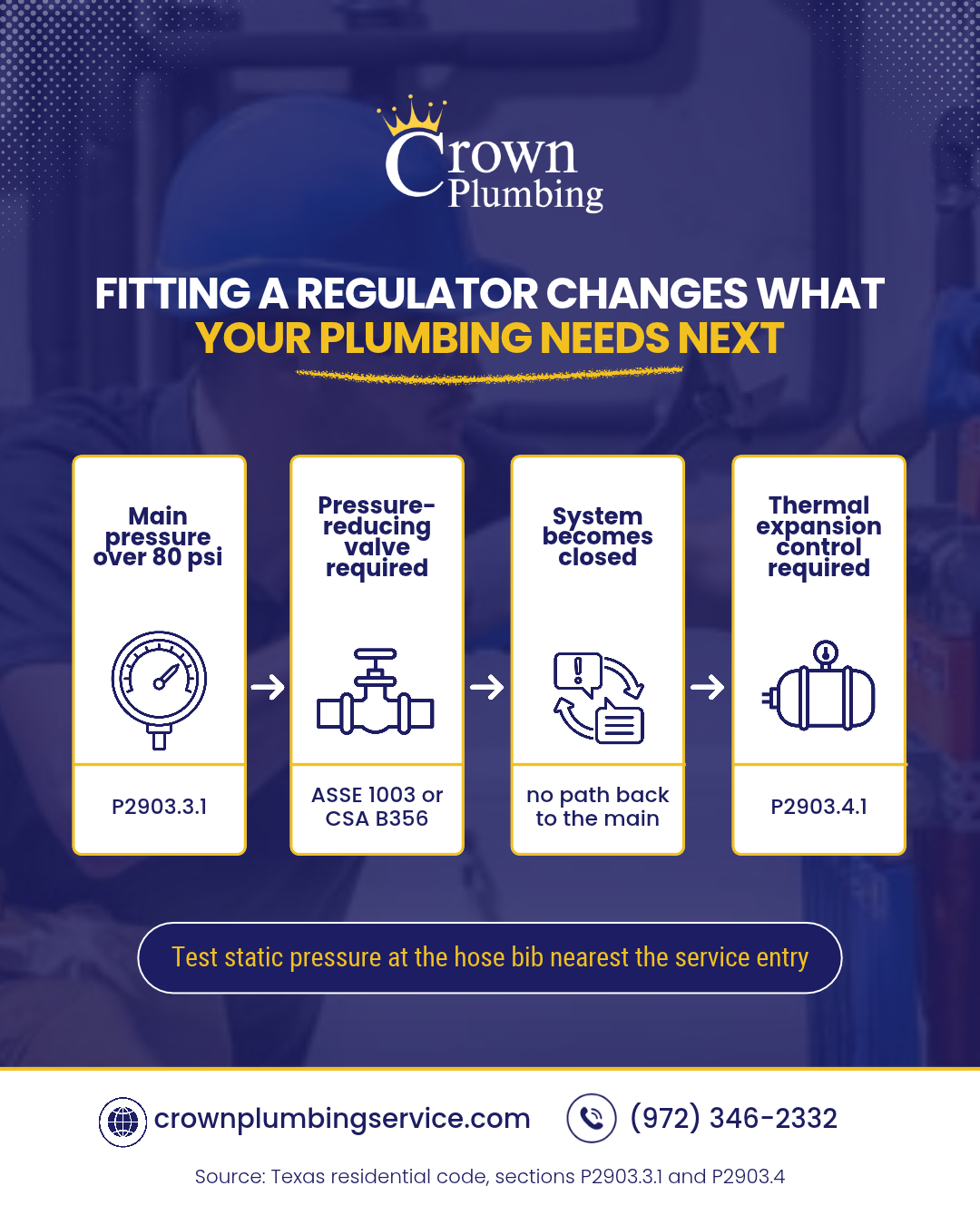
Section P2903.3.1 of the residential code adopted in Texas is short enough to quote in full. Static water pressure “shall not be greater than 80 psi (551 kPa). Where the main pressure exceeds 80 psi (551 kPa), an approved pressure-reducing valve conforming to ASSE 1003 or CSA B356 shall be installed on the domestic water branch main or riser at the connection to the water service pipe.” You can read the whole water supply chapter if you want the surrounding context.
Two things in that sentence matter more than the number.
The first is *static*. That is pressure with nothing running, which is the highest the system sees and the state it sits in for most of the day and all of the night. Testing while a tap is open gives you a lower, friendlier, useless reading.
The second is that the code names a standard for the valve. ASSE 1003 or CSA B356. A regulator that does not carry one of those listings is not the thing the code is asking for, which is worth knowing if somebody offers you a cheap one.
Why This Bites Harder in Newer Suburbs
Municipal systems are not designed to deliver a comfortable domestic pressure to your fixtures. They are designed to hold enough pressure across the whole distribution network, at the far end, on the worst day, with hydrants flowing.
That means the pressure arriving at your meter has more to do with where your house sits relative to the nearest elevated storage than with anything about your house. Two homes a mile apart in the same town can be a long way apart on the gauge.
We work across Prosper, Celina, Frisco, McKinney, Little Elm, and Allen, and the first thing we do on a pressure complaint is put a gauge on a hose bib and look at it. Not estimate it, not infer it from how the shower feels. The reading decides the conversation, and it is frequently not the number the homeowner expected in either direction.
What Living Above the Line Actually Costs
High pressure does not usually announce itself with a burst. It shortens the life of everything quietly and in parallel.
- Supply lines to toilets and faucets, especially the braided ones, spend years being held at a stress they were rated for but not rated to sit at forever.
- Fill valves and mixing cartridges wear faster, which shows up as a toilet that runs and a shower that drips.
- Washing machine and dishwasher inlet solenoids slam shut against a harder column of water. That is the banging you hear.
- The water heater’s temperature and pressure relief valve starts weeping and gets blamed for being faulty when it is doing its job.
- Every joint, fitting, and slab penetration in the house carries more load than the designer assumed.
The Environmental Protection Agency’s WaterSense program puts numbers on where that ends up. The average household’s leaks account for more than 9,300 gallons of water wasted every year, and nine percent of homes have leaks wasting 50 gallons or more per day. Nationally, household leaks come to nearly a trillion gallons annually. Fixing the easily corrected ones, the agency says, saves a household about 10 percent on its water bill.
None of those figures are about pressure specifically. They describe the destination that sustained high pressure keeps pushing a house toward.
Test It Yourself, Properly
A threaded pressure gauge costs less than a pizza and screws onto a hose bib. Getting a trustworthy reading takes a little care.
- Pick the bib closest to where the water service enters the house. The farther away, the more pipe you are reading through.
- Turn off anything that draws water automatically. Irrigation, ice maker, a water softener mid-cycle.
- Tighten the gauge to hand-tight, open the bib fully, and read it.
- Do it again in the early hours if you can, or first thing in the morning. Municipal pressure rises overnight when demand across the network drops, and the overnight number is the one your pipes actually live with.
Under 60 is comfortable. Sixty to 80 is legal and fine. Over 80 and the code has an opinion. Well over 80, and you want to know how long it has been that way.
Write the number down with the date. A single reading tells you where you are today; two readings a year apart tell you whether a regulator is drifting, which is the thing a one-off test can never show. Homeowners who do this catch a failing valve before the house does.
There is a second test worth running while you have ten minutes. The EPA describes it: read your water meter, use no water for two hours, then read it again. If it moved, something is leaking. That test costs nothing and finds the slow failures that never make a noise.
The Part Nobody Mentions Until the Bill Arrives
Here is the consequence that catches people, and it is the reason we would rather explain it before the work than after.
Fitting a pressure-reducing valve turns your plumbing into a closed system. Water can come in past the valve, but it cannot push back out toward the main. The same thing happens if the utility fits a check valve or a backflow preventer at the meter, which is increasingly standard, and many homes are already closed without the owner knowing.
Now heat forty or fifty gallons of water. It expands. In an open system, that expansion pushes gently back out into the street main and nothing happens. In a closed system, it has nowhere to go, so the pressure climbs, sometimes far above the incoming supply pressure, every single time the water heater runs.
The code anticipates exactly this. Section P2903.4 requires a means of controlling increased pressure caused by thermal expansion. P2903.4.1 spells out the pressure-reducing valve case: for water service up to and including two inches, “a device for controlling pressure shall be installed where, because of thermal expansion, the pressure on the downstream side of a pressure-reducing valve exceeds the pressure-reducing valve setting.” P2903.4.2 covers the backflow preventer and check valve case with storage water heating equipment, and asks for the same thing.
That device is normally an expansion tank. We have written separately about what an expansion tank actually does and how to tell if yours has failed, because a waterlogged one looks identical to a working one from the outside.
The sequence is what matters: regulator, then expansion control. A regulator fitted on its own to a house with a storage water heater has solved one problem and created another.
This is also the reason a house can pass a pressure test at the hose bib and still be damaging itself. The gauge outside reads the incoming supply, downstream of the regulator, at rest. It does not see the spike that happens inside the house while the water heater is running and the expansion has nowhere to go. A household with a correctly set regulator, no expansion tank, and a fifty-gallon tank heater can be seeing pressures well above its own regulator setting several times a day, and the only outward sign is a relief valve that occasionally weeps.
Two things make this more common here than it used to be. Utilities across North Texas have been fitting check valves and backflow devices at the meter as standard, which closes systems that were open when the house was built, and nobody tells the homeowner. And the tank water heater is still the default in most of the housing stock we work in, so the expansion is real rather than theoretical.
If your house has a regulator or a meter check valve, and a storage water heater, and no expansion tank, that is the combination to have looked at. It is not an emergency. It is a thing that quietly consumes the life of the water heater and everything downstream of it.
Reading Your Own Symptoms
Some of what gets reported to us as separate faults is one fault.
| What you notice | What it can mean |
| Banging when the washer or dishwasher stops filling | Water hammer, made worse by high static pressure |
| Toilet that runs intermittently for no reason | Fill valve or flapper worn early under pressure |
| Relief valve on the water heater dripping | Thermal expansion in a closed system, or genuine over-temperature |
| Shower drips within a year of a new cartridge | Cartridge wearing faster than it should |
| Pressure that feels fine in the day and fierce at night | Overnight municipal rise, the classic sign to test at 5 am |
| New leak at a fitting nobody touched | The system finding its weakest point |
If three or four of those are true at once, stop treating them individually. Replacing a fill valve, then a cartridge, then a supply line, over eighteen months, at three separate call-out charges, is the expensive way to arrive at a single upstream cause. The gauge costs less than any one of those visits, and it is the first thing we reach for.
What a Regulator Costs You in Comfort
Very little, and this is the objection we hear most. A regulator is adjustable, and set sensibly, showers still feel like showers and the irrigation still runs. What goes away is the harshness, the hammering, and the accelerated wear. Households rarely ask us to put it back.
The exception worth flagging honestly: if the house has undersized supply piping or a partly blocked line, a regulator will make an existing flow problem more obvious. That is a diagnosis to do first rather than a reason to skip the valve. Low flow and high pressure are different complaints and are sometimes present together, which is why we look at low pressure as its own separate question.
Check the Pressure Once a Year, Because Regulators Wear Out
A pressure-reducing valve is a wearing part with a diaphragm and a spring inside it.
They typically give somewhere around a decade of service, and they fail in two directions, which is why the symptom alone will not tell you the valve is the problem. The obvious failure is that pressure climbs back up, which a gauge finds immediately. The less obvious one is that they drift downward, and the household slowly accepts worse and worse flow without ever connecting it to a valve nobody has looked at since the house was built.
If your home is more than ten years old and has a regulator, the useful habit is a gauge reading once a year. It takes longer to find the gauge than to do the test.
Ours is a straightforward job to book if the reading comes back high, and if it comes back at 62 psi, we will tell you that, and you can put the gauge back in the drawer. Booking plumbing services for a pressure test is a small visit, and it is a much smaller visit than the one after a supply line lets go behind a wall.
That is the whole point of writing this down rather than waiting for the call. Crown Plumbing would rather you owned a gauge.

