



 SCHEDULE SERVICE
 CALL 972-346-2332
A tank water heater that carried the whole house through July can start running cold halfway through the second shower in December, and often nothing inside it has failed. The tank holds the same number of gallons and the burner fires at the same rate. What changes is the water coming in from the street, which is colder, so every shower pulls a bigger share of hot water and every gallon takes longer to reheat.
TL;DR
A water heater not keeping up in winter is usually meeting colder supply water, not breaking down. Federal rules test every tank heater with supply water held at 58°F, and the first-hour rating printed on the label comes from that test. When the incoming water runs colder than it did in summer, a shower valve blends in more hot water to reach the same temperature, and the burner or elements need longer to lift each refill gallon back to the setpoint. Both effects shrink the hot water you actually get.
Water that is lukewarm from the first minute, runs out in a few minutes, or comes with rumbling or a leak points to a fault instead. If the label’s first-hour rating was only just enough for a summer morning, winter exposes it, and a heater with a larger burner fixes that better than a larger tank.
Why Does a Water Heater Stop Keeping Up in Winter?
Two things happen at once when the supply water gets colder. At the shower valve, cold water makes up less of the blend, so hot water leaves the tank faster for the same shower. Inside the tank, the refill water starts colder, so the burner or elements need more time to bring each gallon back up. A heater sized close to the line in summer falls behind on both counts.
That is the whole mechanism, and it explains the pattern most households notice. The first shower of the morning is fine. The second is shorter. By the third, somebody is rinsing off in lukewarm water and blaming the heater.
The Federal Test Behind the Number on Your Label
Every tank heater sold in the United States is rated under the Department of Energy’s test procedure for water heaters, published as Appendix E to 10 CFR Part 430 on eCFR. Section 2.3 of that appendix holds the supply water at 58°F, plus or minus 2 degrees, for the whole test. Section 2.4 sets the thermostat so water leaves the heater at 125°F, plus or minus 5.
The appendix defines the first-hour rating as an estimate of the most hot water a tank heater can supply in one hour, starting from a fully heated tank. It is the single best number for a winter shortage question, because it already blends tank size and burner speed into one figure.
How the first-hour test runs
- The tank starts fully heated, with every thermostat satisfied.
- Water is drawn at 3 gallons a minute on any heater of 20 gallons or more.
- Each draw stops when the outlet temperature falls 15 degrees below the highest temperature seen in that draw.
- On a gas heater, the next draw starts when the thermostat cuts back the burner, meaning the tank has caught up again.
- The draws repeat for one hour, and the total volume delivered is the rating.
Read that list again with December in mind. The rating assumes 58°F water arriving at the heater for the entire hour. It says nothing about what your heater delivers when the street sends something colder, and nothing about a summer morning when the water arrives warmer.
The label is a fixed-condition comparison tool, which is exactly what it was built to be. It was never a promise about your garage in January.
The same appendix also sorts heaters into four usage groups by first-hour rating: under 18 gallons, 18 to 51, 51 to 75, and 75 or more. A heater rated in the top group is the one built for a house where several people shower in the same hour.
How Much More Hot Water Does a Shower Take in December?
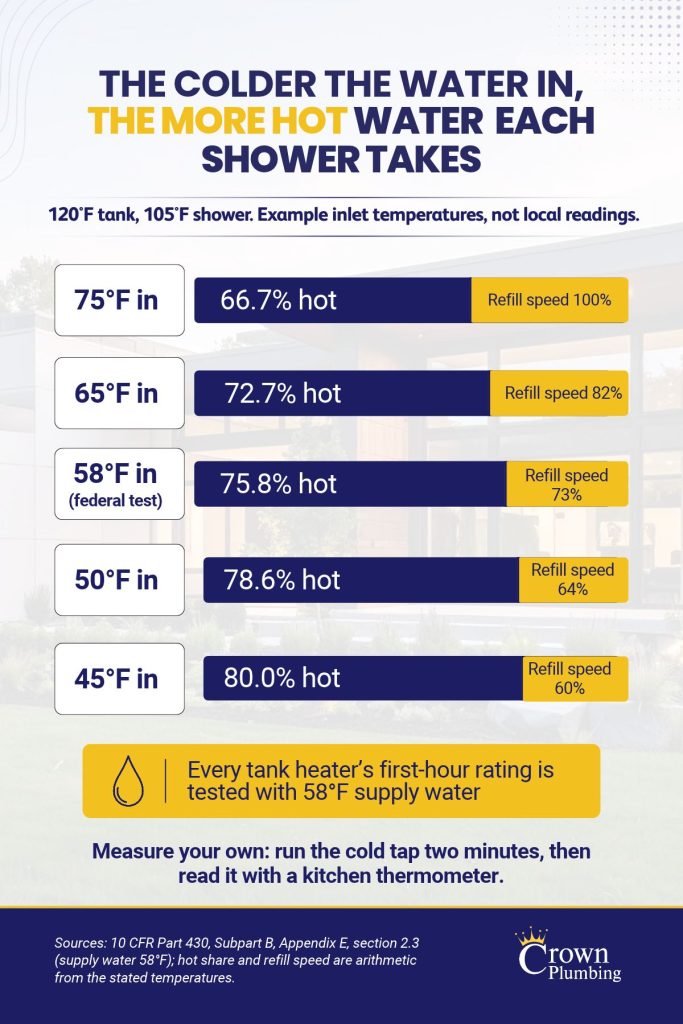
The share of hot water in any shower is set by three temperatures: the shower you want, the tank setpoint, and the cold supply. The formula is simple. Hot share equals the shower temperature minus the cold temperature, divided by the tank temperature minus the cold temperature. Colder supply water raises the hot share every time.
Here is that arithmetic worked through with a 120°F tank and a 105°F shower. The inlet temperatures in the left column are examples picked to show the shape of the math. They are not readings from Prosper or Little Elm mains, because no utility we could find publishes one.
| Cold supply (example) | Hot share of the shower | Hot gallons in every 10 gallons used | Degrees each refill gallon must climb | Refill speed compared with the 75°F row |
|---|---|---|---|---|
| 75°F | 66.7% | 6.7 | 45 | 100% |
| 65°F | 72.7% | 7.3 | 55 | 82% |
| 58°F (the federal test) | 75.8% | 7.6 | 62 | 73% |
| 50°F | 78.6% | 7.9 | 70 | 64% |
| 45°F | 80.0% | 8.0 | 75 | 60% |
The refill column follows from how heat works. A burner or element puts out a fixed amount of heat per hour, so the number of gallons it can reheat in that hour falls in proportion to how many degrees each gallon has to climb.
Put the two effects side by side. Going from the 75°F row to the 45°F row, a shower uses about 20 percent more hot water per minute, and the heater refills only about 60 percent as many gallons per hour. Neither number alone looks dramatic. Together they are the difference between a morning that works and a morning that does not.
That is the part a summer test of the heater can never reveal. A tank that looked fine in August was being helped by the weather.
Where Prosper and Little Elm Tap Water Comes From
Prosper and Little Elm both buy treated water from the North Texas Municipal Water District, which lists the two towns among its customer cities on the district’s water system overview. Frisco, McKinney, Allen, and Plano appear on the same list as member cities. Little Elm’s 2026 water quality report names the sources: Lake Lavon in Collin County, Bois D’Arc Lake near Bonham, Lake Texoma, and Jim Chapman Lake, all surface water.
Lake water follows the seasons. It warms through a North Texas summer and cools through the winter, and the water in the mains under your street follows along. Deep well water holds a steadier temperature through the year, which is part of why winter shortages feel sharper on a lake supply.
So a house in Prosper, Frisco, or the neighborhoods we work in around Little Elm can see the whole effect described above without any change to the heater. The same goes for water heater and drain work in McKinney, on the same regional system.
Taking the reading yourself
You do not need a published number. You can measure your own.
- Run the kitchen cold tap for a couple of minutes so you are reading water from the street, not water that sat in the house.
- Hold a kitchen or candy thermometer in the stream until it settles.
- Write the reading down with the date, then repeat it once a month through the winter.
- Check the hot side the same way first thing in the morning, before anyone showers.
The U.S. Consumer Product Safety Commission suggests that same candy or meat thermometer method for checking hot water at the faucet, so the tool is already in most kitchen drawers. Two readings, cold and hot, turn a vague complaint into numbers anyone can work with.
Tank Size Versus Burner Size
A bigger tank is the first fix most people reach for, and the label data says it is often the weaker one. A. O. Smith’s ProLine gas tank catalog prints the burner input and the first-hour rating side by side for every model, which makes the trade easy to see.
| A. O. Smith model | Tank | Burner input | First-hour rating |
|---|---|---|---|
| GCBL-30R | 30 gallons | 32,000 BTU | 65 gallons |
| GURL-40 | 40 gallons | 40,000 BTU | 72 gallons |
| GCR-40 | 40 gallons | 40,000 BTU | 80 gallons |
| GCR-50 | 50 gallons | 40,000 BTU | 84 gallons |
| PCG-75L | 75 gallons | 75,100 BTU | 125 gallons |
Look at the GCR-40 and the GCR-50. Ten more gallons of tank on the same 40,000 BTU burner buys four more gallons of first-hour rating. The 75-gallon high-recovery model nearly doubles the burner input and lands 45 gallons above the 50.
That gap widens in winter, and the reason sits in the refill column of the mixing table. Stored water is a one-time head start. Once it is used, every additional gallon comes from the burner, and colder supply water slows the burner’s output in gallons. In December, a larger burner earns its keep in a way that a few extra stored gallons cannot.
Two 40-gallon tanks on the same burner rating also list different first-hour ratings, 72 and 80 gallons. That is the honest reason to read the yellow label rather than assume one 40-gallon heater equals another. ENERGY STAR’s buying guidance makes the same point: capacity is on the nameplate or the EnergyGuide sticker, and the first-hour rating is the number to compare.
We use A. O. Smith here because its catalog publishes both numbers in one place. It is an illustration of how the ratings behave, not a brand pick.
Cold Water or a Failing Heater?
Cold supply water shortens the hot water you get, but it does not change how hot the water is at the start, and it does not make noise. Use the pattern to sort the two.
| What you notice | Points to colder supply water | Points to a fault |
|---|---|---|
| First shower of the morning | Hot, normal temperature | Lukewarm from the first minute |
| How fast it runs out | A bit sooner than summer, worst on busy mornings | Within a few minutes, even with one shower running |
| After a quiet hour | Fully back | Still lukewarm |
| Sounds | Normal burner noise | Rumbling or popping from the tank |
| Around the base | Dry | Water in the pan, rust streaks, a wet floor |
Trade knowledge fills in the fault column. Sediment on the bottom of a gas tank insulates the water from the flame, so heat goes up the flue instead of into the water, and the tank rumbles as pockets of trapped water boil. A cracked or broken dip tube lets incoming cold water mix at the top of the tank near the outlet instead of being delivered to the bottom, so the supply turns lukewarm quickly. A gas valve or burner that is not firing at full rate looks like a much smaller heater.
A bigger temperature climb also means more expansion inside the tank on every heating cycle. That is why a worn expansion tank on the cold line often shows itself in the same weeks, usually as a relief valve that starts to drip.
Two thermostats on an electric tank
The CPSC’s scald guidance notes that most electric water heaters have two thermostats, behind upper and lower access panels, and the federal test procedure describes electric heaters whose elements take turns rather than run together.
In practice, the upper element heats the top of the tank first and then hands off to the lower one. When the lower element or its thermostat fails, the top of the tank still gets hot and the first few minutes feel normal. Then the supply quits early, every time, in July as much as in December. A shortage that also happened last summer is a parts problem, not a weather problem.
Both thermostats sit behind live electrical terminals. Cut the breaker before opening a panel, or leave it to us.
Turning the Thermostat Up Is a Trade With Scald Risk
Raising the tank setpoint does stretch the supply, because hotter stored water needs less of itself in each shower. With a 50°F inlet and a 105°F shower, a 120°F tank supplies 78.6 percent of the blend and a 135°F tank supplies about 65 percent.
The cost is burn risk at every tap in the house. The Consumer Product Safety Commission’s Avoiding Tap Water Scalds sheet urges households to set water heaters to 120°F. It says most adults suffer third-degree burns in 30 seconds at 130°F and in six seconds at 140°F, and that even 120°F water can cause them with a five-minute exposure. It notes that most tap water scald injuries and deaths involve the elderly and children under five.
So we treat a higher setpoint as a decision, not a quick fix:
- If anyone in the house is very young or elderly, keep the tank at 120°F and solve the shortage another way.
- If you do raise it, a thermostatic mixing valve at the heater outlet can hold the water sent to the taps at a safe temperature while the tank stores hotter water.
- Check the result at the faucet with the thermometer, not by the marks on the dial, which are rarely labelled in degrees.
What Changes the Outcome, and What Does Not
Some winter habits help at the margin, and some only feel like they should.
Helps: Spacing showers. Twenty minutes between the second and third shower gives the burner time to catch up, and on a heater that is close to the line that is often enough. Running the dishwasher or the washer at night instead of in the morning shower hour does the same.
Helps: Flushing sediment on a gas tank before the cold months. The homes we look after in the area get the tank drained to remove sediment and the heating parts and connections checked as part of a service visit, because a tank that loses heat into a layer of scale has less to give in December.
Does not help much: A bigger tank on the same burner, for the reasons in the catalog table above.
Does not help: Wrapping a modern tank to fix a shortage. Insulation slows standby heat loss while the tank sits. It does nothing for a burner that cannot keep pace with a morning of showers.
Changes the equation: A heater with a higher first-hour rating, a higher-input burner, or a tankless unit sized for winter water. A tankless heater faces the same colder inlet, so it has to be sized for the coldest month rather than the average one.
If the heater is also getting old, the replacement decision and the sizing decision become the same decision. Our breakdown of what a replacement heater costs in Prosper covers permits and the code items a new install has to include.
Take Two Hot Water Readings Before Buying a Bigger Tank
Before anyone sells you a larger heater, take the two thermometer readings and photograph the yellow label. With the inlet temperature, the hot water temperature, and the first-hour rating in hand, the question answers itself. A healthy heater with a first-hour rating that only covers a summer morning needs more burner, not more tank. A heater that runs lukewarm or quits early in any season needs a repair before anyone talks about size.
When the numbers say the heater is undersized for winter, that is the point to talk through water heater installation with a plumber who will size it against your coldest month. We service gas, electric, and propane heaters of every brand. Call Crown Plumbing with your two readings and the label photo, and we can tell you which kind of problem you have before December gets any colder.

