



 SCHEDULE SERVICE
 CALL 972-346-2332
You rinse a plate, and the water sits there for a second before it goes. Not a flood, nothing dramatic. Just a beat longer than it used to take.
That’s worth a look, and there are only a few things it can be.
We’re Crown Plumbing, family-owned in Prosper since 2006, and we’ve worked on kitchens across Collin County ever since. The kitchen sink gets used more times a day than anything else in the house, and it’s the only drain food and fat go down on purpose. So out of every drain in the house, it’s the one that puts us in a driveway.
Here’s what you can try yourself tonight, and what we do about it when it keeps coming back.
TL;DR
- Try hot water and dish soap first, then clean the P-trap under the sink, then plunge properly with the other bowl sealed off. All three are things you can do yourself in about twenty minutes.
- We’d skip the liquid drain cleaner. It doesn’t clear a greased line, and it makes the next step messier for whoever opens the pipe.
- If the sink keeps slowing down, the line needs cleaning rather than clearing. We put a camera in it first, then jet it.
- Crown handles every part of this: drain cleaning, garbage disposals, hydro-jetting, sewer camera inspections, and the faucet, sink, and toilet work that turns up while we’re there.
- Licensed and insured since 2006, License # M-37627, 4.9 stars across 981 reviews. Free estimate, and the price we quote is the price you pay.
- Call us at (972) 346-2332 or book at crownplumbingservice.com.
Why Is My Kitchen Sink Draining Slow?
Grease and food film build up on the inside of the pipe over time and narrow it, so the water still gets through; it just takes longer. A faster slowdown usually points to the P-trap under the sink, the disposal, or the dishwasher sharing the same line. If the sink is slow on both sides, or other fixtures gurgle while the kitchen runs, the restriction has moved further down toward the main. Those are different repairs, which is why we look before we quote. Crown does it on a free estimate, and if the answer is something you can handle yourself, we’ll tell you that.
What You Can Try Tonight, Honestly
A plumbing company walking you through the free fixes first is an odd thing to read; we know. Try them anyway. They cost nothing, they take about twenty minutes, and anything that doesn’t work narrows down where the problem is.
Start with hot water and dish soap
Not boiling. Prosper-area homes built in the last few decades run PVC drain lines, and boiling water at a PVC joint is a risk with no payoff. Very hot tap water does the same work.
Squeeze a generous amount of dish soap into the drain. It’s a degreaser, which is the whole point. Let it sit ten or fifteen minutes, then run very hot water for several minutes straight.
Clean the P-trap
That U-shaped piece of pipe under your sink is designed to come apart, and it catches things. This one is well within reach with a bucket and ten minutes.
Put the bucket underneath, because there’s standing water in there by design. Loosen the two slip nuts at either end by hand if they’re plastic, or with channel-lock pliers if they’re metal. Pull the trap down and look inside. We find sludge, wads of fibrous food, bottle caps, and rings people have been looking for.
Clean it, rinse it, check that the rubber washers are seated with the tapered side facing the joint, and hand-tighten it back on. Run water and watch for drips.
Plunge it properly, which is easy to get wrong
Two things make the difference here:
First, the other bowl. If you have a double sink, water and air take the easy path and come straight up the other side. Stuff a wet rag firmly into that drain and hold it down, or have somebody press a flat stopper over it.
Second, the water level. You need enough standing water to cover the rubber cup completely, or you’re pushing air, and air compresses.
Then plunge with short, firm strokes rather than big dramatic ones, and keep the seal the whole time. Fifteen or twenty seconds, then lift and see. Use a cup plunger, the flat-bottomed kind, not the toilet plunger with the flange hanging down.
What We’d Skip, and Why We’ll Say So
Those products are built for hair and soap, which is a bathroom problem. On a kitchen line, they sit in the standing water above the restriction instead of cutting through it, and then that caustic liquid is sitting in the pipe when somebody opens it. If you’ve already poured some in, no judgment at all, and please just tell us when we arrive so we know what’s in there.
Enzyme treatments get a friendlier caveat. They’re gentle, and they won’t hurt anything, but they’re maintenance rather than repair. They help a line stay clean after it’s been cleaned.
What a Garbage Disposal Is Actually For
A disposal handles the small stuff that comes off a plate during rinsing. Crumbs, bits of sauce, the few grains of rice that survive the scrape into the trash. It does that job well for years.
There are no blades inside one. Two blunt impellers on a spinning plate fling food outward against a grind ring, and the whole thing depends on water carrying the result away.
We’d keep these out of it, and we say so on kitchen visits:
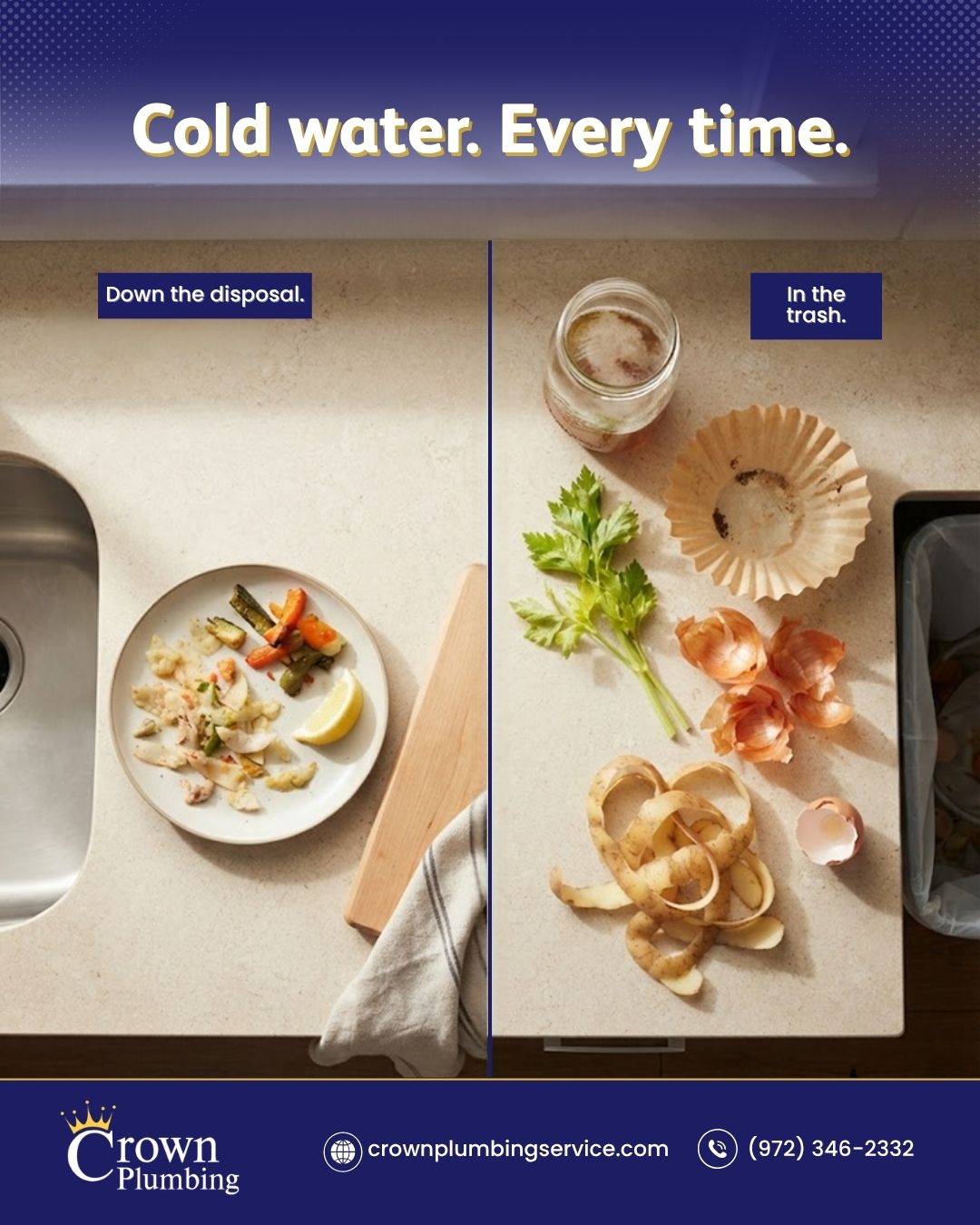
- Grease, oil, and fat in any quantity: The main offender, and the reason your sink slowed down.
- Coffee grounds: They settle and bind with everything else into something like wet sand.
- Fibrous vegetables: Celery, artichoke, corn husks, onion skins. The strings wrap the impellers.
- Starchy foods: Potato peels, pasta, rice. They turn to glue, and they expand.
- Eggshells, bones, and fruit pits.
Run cold water, not hot
This is the one habit worth taking from this page, and it runs against instinct.
Cold water keeps fats firm, so they get chopped into solid pieces and carried out. Hot water melts them into a liquid that flows past the disposal and then cools further down the line.
So: cold water on before you switch it on, cold water the whole time it’s grinding, and cold water for another fifteen or twenty seconds after the motor sounds clear. That last part is the bit that’s easiest to skip.
Crown handles garbage disposal repair and replacement, and we’ll tell you honestly whether yours needs repair or replacement rather than defaulting to the more expensive answer.
When a Disposal Hums, Jams, or Goes Quiet
Three sounds, three meanings, and where the line sits between a five-minute fix and a service call.
It hums but doesn’t turn: The plate is jammed. Switch it off, find the hex socket in the center of the underside, and use the hex key that came with it or any quarter-inch key to work the plate back and forth until it moves freely. Press the red reset button, also underneath. Run cold water and try again.
It’s completely silent: The reset button has tripped, or the breaker has. Press reset first, then check the panel. If both are fine and it still won’t make a sound, the motor or the switch is done, and that’s ours.
It runs, but water backs up anyway: The disposal is working, and the pipe past it isn’t. That’s a drain problem wearing a disposal costume.
It leaks: A leak at the top rim is the sink flange and its putty seal. A leak from the body of the unit means the internal seal has gone. Replacing it once beats chasing it twice.
Why Does My Kitchen Sink Smell?
Because of what’s coating the inside of the pipe, which is the same thing slowing the drain down.
Grind a cut-up lemon or some ice with cold water running, which scours the chamber. Then clean the rubber splash guard, because the underside of that flap holds more grime than anywhere else in the kitchen and it’s easy to forget to flip it up.
A persistent smell that’s more sewer than food is different, and it’s worth a call. It can be a dry trap nearby, a venting issue, or something further down the line. We’ve found all three, and the camera settles it in one visit.
When We Bring the Camera
Here’s how Crown works, and it’s the part worth knowing about us.
If a kitchen line has backed up more than once, we don’t start by running equipment into it and hoping. We put a camera down the line and look first.
A pipe that keeps clogging in the same spot is telling you something, and the something is different every time. We’ve found hardened grease, roots at a joint, a section that settled into a low spot and holds water, an offset where two pieces no longer line up, and cast iron scaled inward to a fraction of its original diameter. Every one of those looks identical from the outside. Every one needs a different answer.
That’s what we mean when we say we find it first, then fix it once. Our video inspection work is the backbone of how we diagnose.
Snaking or Hydro-Jetting, and How We Choose
A cable machine feeds a steel snake into the line and spins it. It’s the right call when something is actually in the way, and when that’s what the line needs, that’s what we run. It’s fast, and it’s less invasive.
Where a snake has limits is on a pipe that’s coated rather than plugged. It bores a channel through the buildup and the water moves again, which feels like success at the sink, but the coating is still on the wall. If a snake has cleared your kitchen line more than once, that’s the line asking for cleaning instead of clearing, and we’d rather say so than keep booking the same visit.
Hydro-jetting runs water through a specialized nozzle at high pressure, forward and backward at once. The forward jets break up what’s in the way, and the rearward jets pull the head through and scour the wall as it goes. The line comes out clean to the pipe wall, which is the repair that ends the cycle. We carry it on the truck year-round, and the cooler months are when we run it most.
Your Pre-Holiday Kitchen Check
Ten minutes, this weekend, nothing technical.
- Fill the sink with a few inches of water and pull the plug. Watch how fast it goes. That’s your baseline.
- Run both bowls at once if you have a double sink and see whether either struggles.
- Open the cabinet and look underneath with a flashlight. You want dry pipe and a dry cabinet floor.
- Flip up the rubber splash guard in the disposal and clean the underside.
- Run the disposal with cold water and listen. Rattling means something loose in the chamber.
- Note whether anything gurgles in the bathroom when the kitchen drains.
If two or three of those gave you grief, book a free estimate with us while the calendar is still open.
What Happens When You Call Crown About a Slow Drain
We’ll ask whether it’s one sink or the whole house, whether anything gurgles, whether it’s happened before, and whether you’ve already tried anything.
Then a technician comes out, checks the disposal, the trap, and the line, and works out whether the restriction is local or further down. If it’s simple, we fix it. If it’s been recurring, we put a camera in it and show you what’s on the screen rather than describing it to you.
You get a fixed price before any work starts, and the estimate is free with no obligation. If the answer turns out to be something a plunger and twenty minutes will fix, we’ll tell you that too. We’ve done it, and we’ll do it again.
Why We Quote a Price That Doesn’t Move
Our price doesn’t change between the estimate and the invoice. What we quote is what you pay.
We’re spelling that out because drain work is an easy place for a number to drift. The pipe is out of sight, the scope is easy to describe vaguely, and you have no way to verify what happened down there. We’d rather remove that from the conversation entirely.
It’s also why we’re comfortable telling you which jobs we don’t think you need. A company that prices by the hour has one set of incentives. A company that quotes the job up front and sticks to it has a different one.
Licensed and insured, License # M-37627, and 4.9 stars across 981 reviews, we’ve earned one kitchen at a time since 2006.
Everything Else We Handle in a Kitchen
While we’re under there, it’s common to find something else that’s been limping along. A trap assembly that’s been added to three times. A disposal that was never the right size for the sink. A faucet that’s been dripping into the base long enough to soften the cabinet floor.
You don’t need a second company for any of it. Crown handles drain cleaning and repair, garbage disposals, hydro-jetting, video inspections, toilet, sink and tub repair and replacement, plumbing remodels, water heaters and tankless conversions, slab leak repair, gas lines, and water filtration. Residential and commercial.
On the commercial side, our commercial service covers high-pressure water jet drain cleaning, grease-prone lines, three-compartment sinks, floor sinks, sewer video inspections, and preventative maintenance plans. If you run a kitchen in Collin County, October beats December for that visit.
Proudly Serving Prosper and the Neighbors
We proudly serve Prosper, Celina, McKinney, Frisco, Allen, Plano, Fairview, Little Elm, Melissa, and Anna, along with the surrounding North Texas and Collin County communities.
That spread matters in drain work, because the housing stock changes as you move across it. Newer builds around Prosper and Celina have PVC drain lines and short, predictable runs. Older neighborhoods in Plano, McKinney, and parts of Allen are where we run into cast iron and lines that have had forty years to accumulate. The sink looks the same either way when you’re standing at it. What’s under the floor is a different animal.
Meet Crown Plumbing: Your Neighbors Since 2006
Crown Plumbing is a family-run business based in Prosper, and we’ve been working in Collin County since 2006.
We’re fully licensed and insured under License # M-37627; we’re certified in LPG, and we handle residential and commercial. No pressure and no scare tactics. If you don’t need it, we’ll tell you.
What Our Prosper Neighbors Are Saying
“Jacob has been to my home several times over the years. He’s polite, knowledgeable, and informative. I appreciate all he has done for me and my home. The office staff is super friendly and helpful.” (Verified Google Review)
“Jacob was prompt, professional, and knowledgeable. He explained the problem and all the options with pricing, which I found reasonable.” (Verified Google Review)
“Our plumber was excellent. He was very professional, persevered through several issues, kept us up to date, and solved the issue. I would highly recommend him and Crown Plumbing.” (Verified Google Review)
“Crown Plumbing came out to fix a hot water slab leak. They were prompt, went through our options with us, and when we chose to have it rerouted, they got a crew and were able to be out and fix it within a few days.” (Verified Google Review)
How Do I Get Started?
If the sink has been taking its time and you’ve already tried the soap and the trap, the next step is a free look.
Call Crown Plumbing at (972) 346-2332 or schedule at crownplumbingservice.com. Family-owned in Prosper since 2006, licensed and insured under License # M-37627, and rated 4.9 stars across 981 reviews. Free estimate, a price that doesn’t move, and a kitchen that’s ready before the cooking starts.

