



 SCHEDULE SERVICE
  CALL 972-346-2332
 A leak between the water meter and your house is yours to find and fix, and the water it wastes shows up on your bill because the meter has already counted it. The better news is that Prosper and Little Elm both run a leak credit that can take some of the sting out of that bill. Both credits come with a 30-day clock and a paperwork test, and plenty of homeowners miss one or the other.
TL;DR
In Prosper and Little Elm, the town’s responsibility stops at the water meter. The buried line from the meter to your foundation belongs to the homeowner, and so does every gallon that escapes from it. Prosper’s code lets a customer ask for a leak adjustment once in 24 months, in writing, within 30 days of the repair, with documentation that states exactly what was fixed and when. Sprinkler lines, toilets, and faucets do not qualify. Little Elm’s form asks for the request within 30 days of the bill date, wants a dated receipt, and credits half of the water portion of the affected months. Confirm the leak with the meter, get it repaired properly, and file straight away.
Where Does the Town’s Pipe End and Yours Begin?
The meter is the line. Everything from the street main up to and through the meter is the utility’s. Everything downstream of it, starting with the buried pipe that runs across your yard to the slab, is yours to maintain and pay for.
Little Elm states this plainly on its own Water Leak Adjustment Request Form. Citing Section 21-149 of the town code, the form says the customer “is responsible for all water that flows through the meter.” Prosper’s code gets to the same place from the other side: to qualify for a credit, you have to swear that the water “was lost after it passed through the town water meter.”
| Stretch of pipe | Who owns it | Who you call |
|---|---|---|
| Street main to the meter | The town | Town utility |
| The meter itself | The town | Town utility |
| Meter to the foundation (the yard line) | You | A licensed plumber |
| Under the slab and inside the walls | You | A licensed plumber |
| Sprinkler lines teed off the yard line | You | Irrigation contractor or plumber |
One wrinkle is worth knowing. If water is bubbling up at the meter box itself, or the meter glass is cracked, that part may be the town’s problem, so ring the utility first. Water surfacing a few feet toward the house, on your side of the box, is almost always on the private side.
How Do You Know the Leak Is in the Yard and Not the House?
You find out with the meter and your own house shutoff, in about the time it takes to drink a coffee. The meter tells you whether water is moving at all. The shutoff tells you which side of the foundation it is moving on.
- Turn off every fixture, the ice maker, the softener regeneration, and the irrigation controller.
- Lift the meter lid and look at the dial. Most meters have a small low-flow indicator, a triangle or star that spins when anything is flowing.
- If the indicator is still, you have no active leak right now. If it turns, write down the full reading.
- Close the main shutoff where the line enters the house. On many North Texas slab homes, it sits near the front hose bib or in the garage.
- Go back to the meter. If it is still moving with the house shut off, the leak is between the meter and that valve. If it stopped, the leak is inside the house or under the slab.
That split matters for everything that follows. A yard line leak is usually a shovel job. A leak past the house shutoff points toward the foundation, and that is where proper leak detection earns its fee, because guessing on a slab costs concrete.
Signs you can see from the driveway
- A strip of lawn that stays green through a dry spell, following a straight line toward the house
- Soft or sunken ground over the route of the line
- A meter box that fills with water between readings
- Pressure that has fallen off at every fixture at once
- A bill that jumps with no new pool, guests, or landscaping to explain it
None of these proves a service line leak by itself. Put two of them together with a meter that keeps moving while the house valve is shut, and the evidence is strong.
Why Late Summer Is When Yard Lines Let Go
The clay does it. Much of the ground under our part of North Texas is Blackland Prairie clay, and it moves more than most homeowners realize.
The USDA’s official series description for Houston Black clay, the textbook clay of the Texas Blackland Prairies, records a high shrink-swell potential. When it dries, it opens cracks 1/2 to 4 inches wide that reach 12 inches or more below the surface, and those cracks stay open for 90 to 150 cumulative days in most years. A water line buried in that soil is being squeezed and let go on a seasonal cycle.
Not every lot in Prosper or Celina sits on that exact soil series, but the clays around here move in a similar way. Prosper’s own code lists settlement among the causes it accepts for a credit. We are at the tail of a Texas summer now, so this is a sensible month to run the meter test above.
What Prosper Will Credit, and What It Will Not
Prosper’s rules live in Section 13.07.002 of the Town of Prosper Code of Ordinances, under the heading “Adjustment of bill as result of defect in customer’s line.” The code calls a qualifying leak an “excusable defect,” and its definition is narrower than people expect.
It covers “a rupture or leakage of the customer’s underground water lines from the meter to the foundation and/or under the foundation.” So the yard line qualifies, and so does a leak under the slab. The same ordinance then lists what it does not cover.
| Qualifies in Prosper | Does not qualify in Prosper |
|---|---|
| Underground line from the meter to the foundation | Faucets, inside or outside |
| Lines under the foundation | Plumbing inside the walls |
| Breaks caused by freezing, settlement, corrosion, wear, or accident | Sprinkler systems, heads, lines and solenoids |
| Swimming pools and auto-fill pool equipment | |
| Toilets and toilet flappers | |
| Outdoor kitchens and other outdoor fixtures |
The sprinkler exclusion is the one that catches people. A lot of yard leaks in this area turn out to be at an irrigation tee or a cracked lateral rather than the service line itself. That water is lost all the same, but it will not earn a Prosper credit, so the invoice has to say honestly which pipe failed. If irrigation turns out to be the culprit, the next job is tuning a sprinkler system so it stops wasting water.
How the Prosper math works
The ordinance sets out the calculation, and it is kinder than a flat refund in one way and stricter in another.
- Your normal use is taken as the average of the previous nine months.
- Water above that average is billed at one-half of the regular rate.
- The adjustment covers a period of no more than two consecutive months.
- You can have one adjustment in any 24 months.
- You still pay the bill in full by its due date while the town reviews the application.
Two procedural lines in Section 13.07.002 decide most applications. The request has to reach the Utility Billing Department within 30 days of the repair, and “shutting off the water does not qualify as a repair.” Closing the valve at the meter and waiting until next month does not start the clock.
The application itself is a sworn statement. The code asks for the date the leak was discovered and the date it was repaired, whether any new fixtures, pools, or hot tubs went into use during the billing period, and a certification that the application contains no false statements. Treat it the way you would treat a tax form: fill it in from the invoice, not from memory, and keep a copy of everything you send.
Little Elm Runs a Different Clock
Little Elm, over in Denton County, offers a credit too, and its form frames it plainly as a courtesy and “not an entitlement.” The details differ from Prosper’s in ways that change what you should do first.
| Prosper | Little Elm | |
|---|---|---|
| Deadline | 30 days from the repair | 30 days from the date the bill was issued |
| How often | Once in 24 months | Once in 24 months |
| Proof | Documentation of the exact nature and date of repair | Dated receipt, or a signed letter explaining the repair |
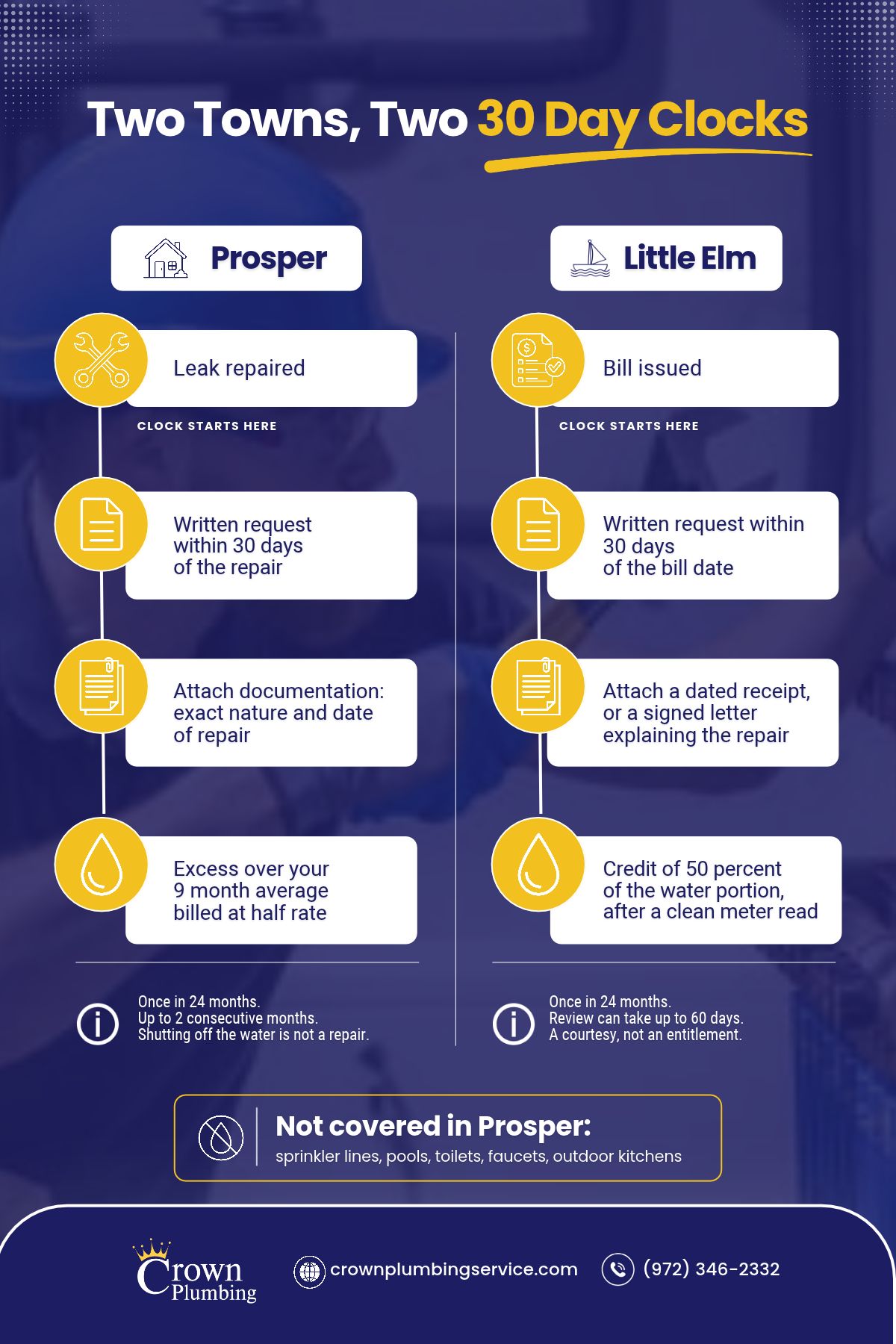
| Credit | Excess over the 9-month average billed at half rate | 50 percent of the water portion of the affected months |
| Review | Final determination by the billing official | Needs a clean meter read after the repair; can take up to 60 days |
The Little Elm deadline runs from the bill, not the repair. If a high bill lands and you spend three weeks deciding whether the leak is real, most of your window is gone before a plumber has touched a shovel. Make the call early, and ask the town what it needs while the repair is being booked.
We work across Prosper, Celina, Frisco, McKinney, Little Elm, and the towns around them in Collin and Denton counties, and every utility sets its own terms. The two towns above are the ones whose rules we have read line by line for this article. If you are on another town’s water, or a special utility district, pull that utility’s billing page before you assume either set of terms applies. Our notes on the work we do for homeowners in Little Elm cover the rest of what we handle there.
What Should the Repair Invoice Say?
The invoice should say what failed, where it was, when it was found, and when it was fixed. Prosper’s code requires documentation “detailing the exact nature and date of repair(s),” and Little Elm’s staff check the repair date, whether the bill is legible, and the repair type. A vague receipt that says “leak repair” can cost you the credit.
Here is what we put on a yard line invoice, and what you should ask any plumber to include:
- The date the leak was located and the date it was repaired, as two separate entries
- Where it was: between the meter and the foundation, under the slab, or at an irrigation tee
- What failed, in plain words: a split in the line, a failed coupling, a crushed section
- What was replaced, and how many feet of pipe
- How it was confirmed afterward, such as the meter standing still with everything off
- The property address, matching the utility account
That last line sounds fussy. It is also the difference between an application that gets processed and one that comes back with a question. Keep a photo of the open trench and the failed piece of pipe on your phone as well. Neither town asks for photos, but they answer questions before anyone has to ask.
A good diagnosis makes a better invoice. When we trace a leak, we pressure test, use thermal imaging and moisture meters, and use a camera where it helps, which is how we test before we dig. The findings go on the paperwork, so the town sees a cause, not a guess.
Spot Repair or a New Line to the House?
Most yard line leaks are a single failed point, and a spot repair fixes them. A dig at the wet spot, a cut out of the damaged section, a new coupling, and a pressure check can put the line back in service the same visit.
Replacement starts to make sense when the history says the line is tired:
- It has failed before, in a different spot
- The pipe material is brittle or corroded where we exposed it
- The route runs under a driveway, a patio, or a mature tree, so the next break will be harder to reach
- The leak was caused by the clay moving the whole run rather than one bad fitting
We will tell you which one we see and why, and put the reasoning on the invoice so the town has it too. If the meter test pointed past the house shutoff instead, the conversation changes, and our breakdown of what an under-slab repair involves and costs is the better starting point.
Run the Meter Test Tonight, Then Book the Repair
Pick an evening when nobody needs the water for half an hour. Shut everything off, read the meter, close the house valve, and read it again. If the dial keeps moving with the house closed, you have a leak on your side of the meter, and the clock on your credit is about to matter.
If water is actually coming up out of the ground or into the house, stop and read what to do in the first hour of a leak before anything else.
Then call Crown Plumbing and tell us what the meter did. We will find the leak, fix it, and hand you an invoice written in the utility’s form, with the dates, the location, and the cause spelled out. File it the same week. Thirty days goes faster than it sounds when you are also cleaning up a trench in the front yard.

