



 SCHEDULE SERVICE
  CALL 972-346-2332
 Quick answer
A fair plumber’s hourly rate in DFW for 2026 is $90 to $150 per hour for residential service work, plus a $50 to $95 service call fee. Flat-rate jobs are common: simple toilet rebuilds run $180 to $320, water heater replacement $1,400 to $2,800, and slab leak detection $250 to $500. Anything labeled “diagnostic fee” above $150 or a quote that triples after the technician arrives is the warning sign of an upsell shop. Always get a written quote before authorizing work.
Plumbers’ prices work two ways, and the better choice depends on the job.
Hourly billing charges for actual time on site, usually with a one-hour minimum. Common in older companies and for diagnostic-heavy work like leak hunts and drain camera inspections. Hourly rates in DFW for licensed residential plumbers run $90 to $150. Apprentices working under supervision are billed at $60 to $90.
Flat rate quotes a single price for the whole job, regardless of how long it takes. Plumbing services in DFW have moved to a flat rate over the past decade because it eliminates billing disputes and gives the customer certainty.
Flat rate is better for the customer when:
- The job is straightforward, and the plumber knows the scope (toilet rebuild, faucet swap, water heater replacement)
- You want a known price before authorizing work
- You suspect the technician might “find” extra problems if billing by the hour
Hourly is better when:
- The problem is undefined and requires diagnosis
- You have a known relationship with a plumber who works fast
- The scope might shrink (sometimes the fix is simpler than expected)
If a plumber refuses to give a flat rate for a clearly defined job, that is a yellow flag. The flat rate already includes their margin. They have no incentive to slow-roll the work.
The 2026 DFW residential price book
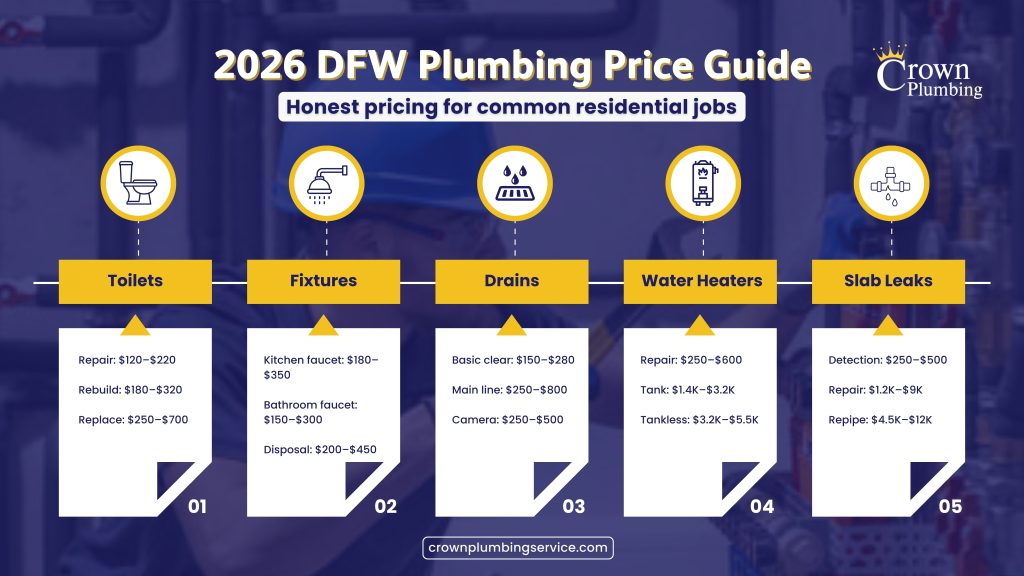
Honest market pricing for the most common residential calls.
Toilet rebuilds and replacements
- Toilet flapper or fill valve replacement: $120 to $220 flat
- Full toilet rebuild (flapper, fill valve, supply line, wax ring): $180 to $320
- Toilet replacement (you supply toilet): $250 to $400
- Toilet replacement (plumber supplies mid-grade toilet): $400 to $700
Faucets and fixtures
- Kitchen faucet replacement: $180 to $350
- Bathroom faucet replacement: $150 to $300
- Showerhead and valve replacement: $300 to $750 (depends on access)
- Garbage disposal replacement: $200 to $450
Drain cleaning
- Sink or tub drain cleared with cable: $150 to $280
- Main line auger from cleanout: $250 to $450
- Hydro jet main line: $400 to $800
- Camera inspection: $250 to $500
Water heaters
- Tankless water heater repair (igniter, gas valve): $250 to $600
- 40 to 50 gallon tank replacement: $1,400 to $2,400
- 75+ gallon tank replacement: $2,000 to $3,200
- Tankless install (new): $3,200 to $5,500
Slab leaks (very common in North Texas due to soil movement)
- Detection with electronic equipment: $250 to $500
- Re-route around slab leak: $1,200 to $3,000
- Tunnel and repair under slab: $4,000 to $9,000
- Full repipe: $4,500 to $12,000
Sewer and main line
- Sewer line snake and clear: $250 to $450
- Sewer line replacement (per linear foot): $80 to $250 trenched, $150 to $350 trenchless
Whole-house items
- Pressure regulator replacement: $250 to $450
- Expansion tank replacement: $180 to $320
- Whole-house shutoff valve replacement: $250 to $500
- Yard hydrant or hose bib replacement: $180 to $350
These ranges are typical for established licensed companies. Cut-rate handymen quote 30% lower but rarely pull permits or carry liability insurance. Premium-brand companies with heavy advertising charge 30 to 80% higher, and the work is often subcontracted.
What a fair service call fee looks like
The service call fee covers the cost of dispatching a truck and technician to your home. Fair range is $50 to $95.
Companies that handle the fee well:
- Apply the fee toward the work if you authorize the repair
- Quote it on the phone before booking
- Charge it once per visit, not per problem looked at
Red flag fee structures:
- “Diagnostic fee” of $150 to $350, separate from any repair work, not applied to the bill
- Multiple fees for looking at multiple issues at one visit
- Fees that escalate after the technician arrives (“this needs special equipment to diagnose”)
If you call for a leaky faucet and an upfront $200 diagnostic fee, that is a bait pricing structure. The $200 is the company’s true minimum, and the “service call” advertised online was marketing.
Common upsell tactics to recognize
The plumbing industry has known upsell scripts. Learn the patterns.
Water heater scare tactics: The technician arrives for a different problem and announces your water heater is “near failure” with rust, corrosion, or sediment. Pushes for replacement at $2,400+. The truth: water heaters last 8 to 14 years. If yours is under 8 years and not actively leaking, it has years of life left. Sediment is normal and flushable.
Pressure regulator urgency: Your home pressure is 95 PSI, the code maximum is 80. You must replace this today. Sometimes legitimate, often inflated. Test pressure yourself with a $12 hose-bib gauge before authorizing.
Whole house repipe push: A single pinhole leak in a copper line becomes the entire house needs repiping. A real repipe recommendation requires multiple leak histories, water quality testing, and pipe-age verification. One leak does not justify a $6,000 repipe.
Bait price online, real price on site: Ads showing $49 drain cleaning. The technician arrives, says, This needs hydro jetting, that’s $800. Always confirm the advertised service applies before booking.
Membership program pressure: Sign up for our $25/month maintenance plan, and we’ll waive the service call. Some plans have value; most do not. Read what the plan actually covers. Many cover only a discount on future work and an annual inspection that takes 20 minutes.
The two-technician quote. A technician arrives, looks at the job, and calls a senior tech or manager who quotes a number 50% higher than expected. The senior tech often does not exist. The script is designed to make you feel the price is firm because two people approved it.
Code violation theatrics: This is a code violation; we have to fix it before we can do the job you called us for. Sometimes legitimate, often inflated. Ask for the specific IPC or local code reference. Real code issues are documented.
Why free estimate plumbers often cost more
Free estimates sound great until you realize the cost of dispatching a truck has to come from somewhere. Companies offering free estimates either:
- Build the cost into inflated job pricing (the $400 toilet rebuild)
- Push hard upsells to make the trip profitable
- Subcontract to commission-only technicians who must close to get paid
A reasonable $50 to $95 service call fee, applied to the work if you authorize, signals an honest pricing structure. The cost of the visit is transparent, and the technician is not pressured to pad the bill.
This pattern is consistent across home service trades. Free estimates correlate with higher final bills.
Emergency and after-hours pricing
After-hours, weekend, and holiday rates run 1.5x to 2x standard pricing.
True emergencies that justify the premium:
- Active flooding from a burst pipe or supply line
- Sewer backup into the home
- No water in the house, and the family is present
- Gas line leak
Issues that can wait until morning:
- Slow drain
- Running toilet
- Leaking faucet (turn off the supply valve under the sink)
- One sink is not draining
- Water heater out (cold shower for one morning)
If your situation can wait, book the next standard appointment instead of paying the emergency fee. A $300 weekday call becomes $500 to $600 on a Sunday night.
Permit costs and when they apply
Most cities in DFW require permits for these plumbing jobs:
- Water heater replacement
- Sewer line work
- Slab leak repairs
- Whole house repipe
- New gas line installation
Permit fees in DFW range from $40 to $250, depending on the city and job. Some plumbers bundle the permit cost into the quote. Others list it separately.
A licensed plumber pulling a permit means an inspector verifies the work meets code. Skipping permits is common but creates problems when you sell the home and the inspector finds unpermitted work.
If a plumber suggests skipping the permit to save money, you have learned something useful about that company.
Warranty: what is normal and what is fluff
Standard residential plumbing warranty in DFW:
- 1 year of labor for most repair work (industry standard)
- 2 to 5 years on installations for water heaters, fixtures, and equipment
- Manufacturer warranty pass-through on parts (varies by manufacturer)
Some companies advertise “lifetime warranties” that cover only specific parts under specific conditions. Read the warranty document, not the marketing copy. A real warranty specifies what is covered, for how long, and what voids it.
Common warranty exclusions:
- Damage from water quality (hard water, low pH)
- Customer-supplied parts
- Acts of God (freeze events, lightning)
- Normal wear and tear
A 10-year warranty on a water heater that excludes hard water in a region with hard water is a marketing tool, not a real warranty.
How to vet a plumber before they show up
Before booking, verify three things in five minutes.
- License lookup. Texas State Board of Plumbing Examiners has a free online license search. Verify the company has a Master Plumber on staff with an active license. Apprentices and journeymen need a master plumber to operate.
- Insurance. Ask for proof of general liability insurance ($1M minimum is industry standard) and workers’ comp. A reputable company emails a certificate of insurance within minutes.
- Reviews with detail. Skip the star count. Read 5 detailed reviews. Real reviews mention specific problems, prices, and named technicians. Fake review patterns include vague praise, identical phrasing across reviews, and clusters of 5-star reviews on the same week.
Final Thoughts
Plumbing pricing in DFW becomes much easier to understand once you know what’s standard, what’s inflated, and how different companies structure their quotes. The real difference between a fair price and an overpriced job usually isn’t the repair itself; it’s how clearly the scope and pricing are explained before any work begins.
A reliable plumber should be able to give you a clear written estimate, explain whether the issue is truly necessary to fix right away, and avoid changing the scope once they arrive on-site. When that transparency is missing, it’s usually where unexpected costs start to show up.
At Crown Plumbing Service, the focus is on straightforward pricing, licensed work, and honest recommendations so homeowners can make decisions with confidence and no pressure.

