



 SCHEDULE SERVICE
  CALL 972-346-2332
 Most water filtration repairs in Prosper and Collin County run $85 to $500, and the price tracks the part that failed, not the brand on the tank. A cartridge or filter swap sits at the low end, around $85 to $175 with labor. A valve or control head rebuild lands in the middle, roughly $250 to $600. Media or resin change-outs run $400 to $900 depending on tank size. Once a repair quote climbs past half the cost of a new system, replacement usually wins. Our local water is very hard (17.2 grains per gallon on the NTMWD supply), so the parts that wear first here are seals, resin, and valves, not the tank itself.
What This Cost Breakdown Actually Covers
Pricing a filtration fix is confusing because “water filtration system” covers four very different machines, and each fails in its own way. A three-stage under-sink drinking filter has almost nothing in common with a whole-house softener sitting in your garage, yet both get lumped under the same search. Below, we separate the real repair costs by the part that broke, give honest ranges we see on Prosper and Celina jobs, and show you the point where fixing an old unit stops making financial sense. We also get into why North Texas water eats certain parts faster than the national averages assume, which changes the math on repair versus replace more than most cost guides admit. If you want the step-by-step of how a specific fix is done, that is a different topic, and our water filtration system repair service page covers the hands-on side. This one is about money.
Water Filtration Repair Cost By Part
The single biggest driver of a repair bill is which component failed. Here is how the common ones break down for a typical Collin County home. These are labor-plus-part ranges, not part-only prices, and they assume normal access (a unit in a garage or under a sink, not buried behind a finished wall).
| What failed | Typical repair cost | How often do we see it |
| Filter cartridge (sediment/carbon) | $85 to $175 | Very common, every 3 to 12 months |
| RO membrane (under-sink drinking systems) | $150 to $300 | Every 2 to 5 years |
| Control valve seals / O-rings | $175 to $350 | Common on softeners past year 5 |
| Full control head/valve replacement | $350 to $600 | Common past year 8 to 10 |
| Softener resin/media change-out | $400 to $900 | Every 8 to 12 years, sooner here |
| Motor or timer on a metered valve | $200 to $450 | Occasional |
A few of these deserve a closer look, because the label on the invoice does not always tell you what really went wrong.
Cartridge and membrane swaps
This is the cheapest and most frequent water filtration repair, and honestly, a lot of it is maintenance that got skipped. On a standard under-sink unit, replacing the sediment and carbon cartridges runs about $85 to $150, including the parts and a service call. Reverse-osmosis membranes cost more because the membrane itself is pricier and the system has more stages to flush and sanitize, so a full RO service with new pre-filters and membrane usually lands at $175 to $300. If your only symptom is slow flow or a funny taste, this is likely all you need.
Valve and control head work
The valve is the brain of a whole-house softener or filter, and it is where most of the real repair money goes. A worn set of internal seals and O-rings, the most common softener failure we see locally, runs $175 to $350 to rebuild. If the valve body itself is cracked or the control head has failed electronically, you are looking at $350 to $600 for a full head replacement. The distinction matters: a seal kit is a repair, a new head is closer to a partial rebuild, and we will always tell you which one you actually need before we open anything up.
Media and resin change-outs
Inside a softener tank sits a bed of resin beads that do the actual softening. They do not last forever, and here in North Texas, they wear out faster than the brochures claim (more on why below). A resin change-out runs $400 to $900 depending on tank size, because it means draining, vacuuming, and reloading 40 to 80 pounds of media. On a carbon whole-house filter, the equivalent job is a media rebed and costs about the same. This is real work, and it is the repair most likely to push a homeowner toward considering a full replacement instead.
Why North Texas Water Changes The Repair Math
Here is the practitioner’s detail: almost no national cost guide mentions it, and it is the reason repair estimates written for the average U.S. home are often wrong for us. The Town of Prosper’s water runs about 17.2 grains per gallon, which is classified as very hard, and it comes from the North Texas Municipal Water District. NTMWD disinfects with chloramine, a blend of chlorine and ammonia, not straight chlorine.
That combination is hard on filtration equipment in a specific way. Chloramine is more aggressive toward the rubber seals, O-rings, and resin beads inside a softener than the water most manufacturers design their warranty schedules around. In our experience on Prosper, Celina, and Aubrey jobs, that means two things: softener resin that a spec sheet promises will last 10 to 15 years often starts fading here around year 7 or 8, and valve seals dry out and leak sooner than they would in a soft-water region. Add the district’s periodic chlorine burns (short stretches when they switch off chloramine and run straight chlorine to scour the lines), and rubber components get an extra beating a couple of times a year, making regular plumbing service an important part of protecting your filtration system.
The upshot for a repair decision: a valve or seal failure at year 6 is normal here and almost always worth repairing. A resin bed that is done at year 8 is also normal here, and whether you repair or replace depends less on age and more on the condition of the tank and valve around it. If the valve is healthy and only the resin is spent, a $400 to $900 rebed is the smart money. If the valve is also worn, you are stacking two repairs, and replacement starts to make sense.
Repair Costs By System Type
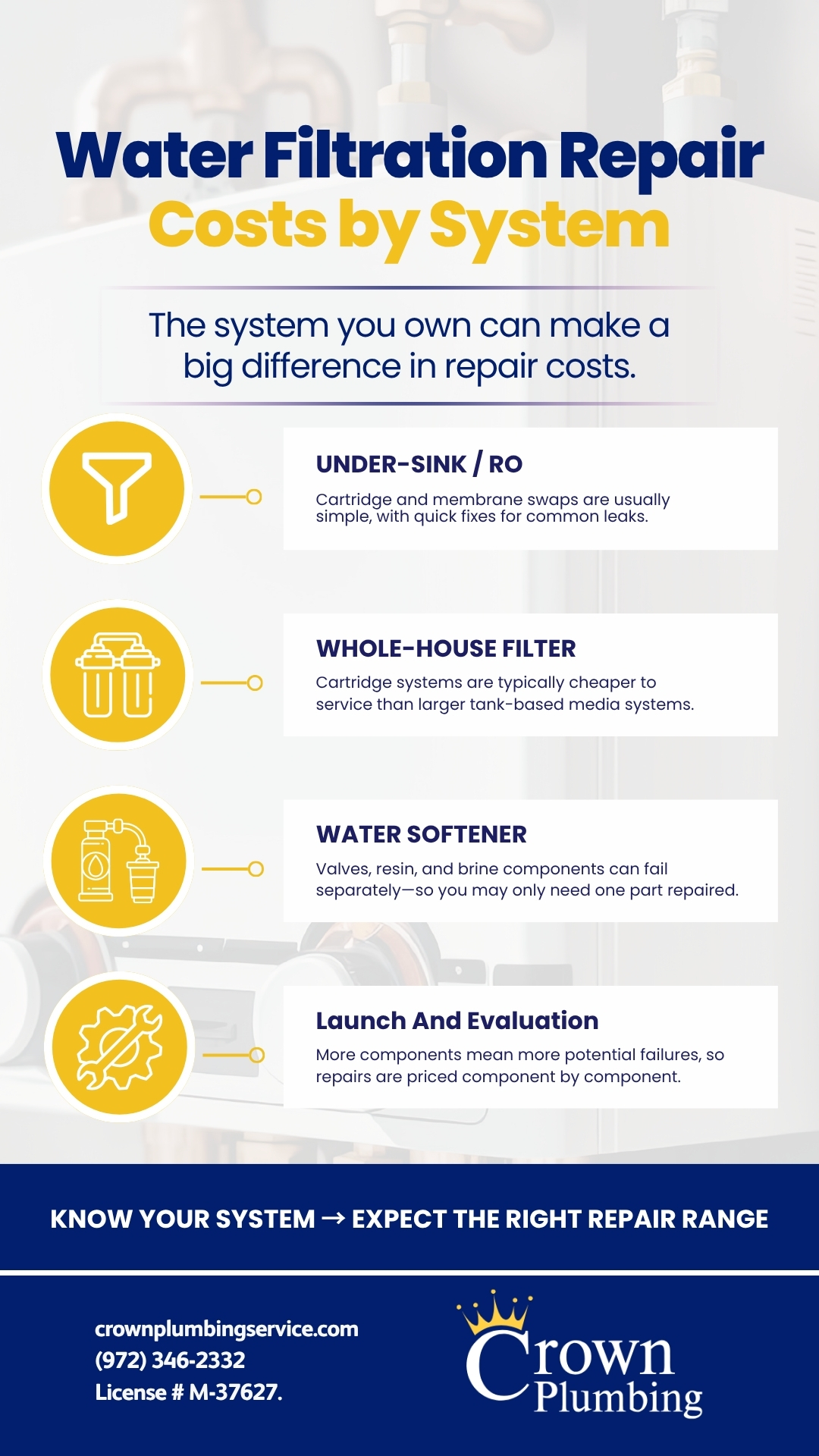
The four systems under the “water filtration” umbrella carry different repair bills because they are built differently, and knowing which one you own tells you roughly where your quote will land before we even arrive.
An under-sink drinking filter or RO unit is the least expensive to fix. It has small, standardized cartridges and a compact footprint, so most jobs are a cartridge or membrane swap in the $85 to $300 band. A leak here is usually a tired push-fit fitting or a failed check valve, both quick fixes.
A whole-house carbon or sediment filter costs a bit more when it needs attention, mainly because the media bed is larger and a rebed takes real labor. Cartridge-style whole-house units are cheaper to service than tank-based ones, since you are swapping a big cartridge instead of vacuuming out spent carbon.
A water softener is the system that generates the most repair calls in this area, and it is the one where the North Texas hardness really shows up on the invoice. The valve, the resin, and the brine components all wear, and any of the three can fail independently. That is a good thing for your wallet, because it means you can often fix the one part that broke rather than scrap the whole unit.
A combination softener-plus-filter system carries the highest ceiling simply because more parts can go. When one of these needs work, we price it component by component so you can see whether one repair or two is driving the number.
When Repair Beats Replacement (And When It Doesn’t)
The honest rule we use on every water filtration system repair call is simple: if the repair quote is more than about half the cost of a comparable new system, replacement usually wins. A new whole-house softener installed runs in the low four figures, so a single $300 valve rebuild is an easy yes. Two failures at once, a bad valve plus spent resin totaling $800 to $1,000, on a unit already past year 10, is where we start showing you replacement numbers instead.
Repair is the clear winner when:
- The tank is sound, and only one part (cartridge, membrane, seal kit, or motor) has failed.
- The unit is under 8 years old, and the failure is a normal wear item.
- The system was sized correctly for your home and household when installed.
Replacement usually makes more sense when:
- The valve and the resin are both worn out on the same visit.
- The unit is 12-plus years old, and parts are getting hard to source.
- The system was undersized to begin with and never kept up with your water usage.
We do not push replacement just because it is a bigger ticket. Plenty of “dead” systems we get called out to look at need a $175 seal kit, not a new tank. But we also will not sell you a $600 valve for a unit that is going to need everything else replaced inside two years. The whole point of a repair estimate is to tell you which side of that line you are on.
What Drives Your Final Water Filtration Repair Price
Two homes with the identical system can get different quotes, and it is usually one of these factors. Access is a big one: a softener sitting in an open garage is a quick job, while one boxed into a finished utility closet with no drain nearby takes longer. Parts availability matters too, because an older or discontinued brand can mean sourcing a universal valve instead of an exact match. Water usage plays a part, since a large household on very hard water cycles the system harder and wears parts faster, which can mean a bigger repair when it finally comes due. And a system that was never maintained (no cartridge changes, no salt kept up) often needs more than the one part you called about. None of these are upsells; they are just the reality of what is behind the panel once we open it.
Timing matters too. A cartridge you replace on schedule is a routine service call. The same cartridge left in place until it clogs solid and starts starving can drag debris into the valve downstream, and now you are paying to clean or rebuild the valve as well. Catching a filtration problem early is almost always the difference between a low-end repair and a mid-range one, which is why we tell customers not to sit on a taste change, a pressure drop, or a small weep at a fitting.
Where to go from here
If your filtered water tastes off, your softener stopped softening, or you spot a leak at the valve, the cheapest move is to get it looked at before a small failure turns into a flooded utility closet. Most fixes in Prosper and Collin County are far closer to the $175 seal-kit end than the full-replacement end, and a straight answer on repair versus replace costs you nothing. When you are ready for eyes on it, Crown Plumbing Service gives you an honest read on what your system actually needs, priced for our very hard North Texas water and the parts it wears out first.

