



 SCHEDULE SERVICE
  CALL 972-346-2332
 Quick answer
Most whole-house water filters need cartridge replacement every 3 to 6 months for sediment filters, 6 to 12 months for carbon block filters, and a full annual service that includes housing inspection, gasket replacement, and pressure check. Signs you are overdue: reduced water pressure throughout the house, return of chlorine taste or odor, visible sediment in fixtures, or it has been more than 12 months since the last service. Filter cartridges run $20 to $80 each. Annual professional service is $120 to $250.
Most whole-house systems have one to three stages.
Stage 1: Sediment filter. Pleated or spun polypropylene captures rust, sand, and debris. Looks like a white pleated cylinder when new. Turns brown to black as it loads. Restricts flow when fully loaded. Lifespan is governed entirely by how dirty your incoming water is.
Stage 2: Carbon block or GAC (granular activated carbon). Removes chlorine, taste, odor, and many volatile organic compounds. Carbon adsorbs contaminants until the surface area is saturated. Once saturated, it stops removing contaminants but does not visibly change. This is why the failure is silent.
Stage 3: Specialty media (optional). KDF for chloramines, calcite for pH balance, and iron-removal media. Each has its own lifespan from 6 months to 5 years.
Knowing which stages your system has tells you the maintenance schedule.
Replacement schedule by filter type
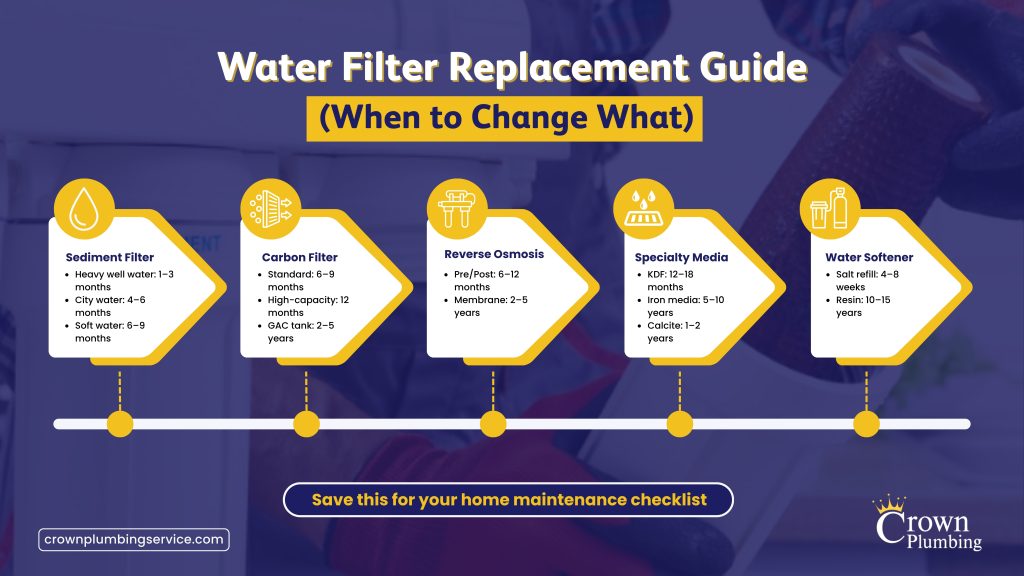
Sediment pre-filter
- Well water with high turbidity: every 1 to 3 months
- Average city water: every 4 to 6 months
- Soft city water with low sediment: every 6 to 9 months
Carbon block filter
- Standard 5-micron carbon: every 6 to 9 months
- High-capacity carbon block: every 12 months
- GAC tank (whole-tank refill): every 2 to 5 years
Reverse osmosis (point of use, not whole-house, but often combined)
- Pre and post filters: every 6 to 12 months
- RO membrane: every 2 to 5 years
KDF or specialty media
- KDF cartridge: every 12 to 18 months
- Iron filter media: every 5 to 10 years (regenerates with backwash)
- Calcite media: top off every 1 to 2 years
Water softener salt
- Most homes: refill every 4 to 8 weeks, depending on usage and hardness
- Resin replacement: every 10 to 15 years
If you do not know what stages you have, look at the housings under your filter system. Sediment filters are usually clear or blue housings. Carbon is usually a dark cartridge in a similar housing. Specialty media is often in a tall fiberglass tank with a control valve on top.
Hard signs your filter needs service now
Filters fail in detectable ways. If you see any of these, schedule service.
Reduced water pressure throughout the house: A clogged sediment filter is the most common cause. The system bottlenecks at the loaded cartridge.
Return of chlorine taste or smell: If your tap water tasted clean for months and now tastes like a swimming pool, the carbon stage is saturated.
Visible sediment in faucet aerators: Unscrew the aerator at any sink. If you see grit or rust, sediment is bypassing the filter (often because the filter is so loaded it has channeled).
Discolored water at any tap: Yellow, brown, or red water indicates either a failed sediment filter or an iron breakthrough.
Cloudy water that does not clear after sitting: Air-related cloudiness clears in 30 seconds. Sediment-related cloudiness does not.
Bypass valve in use: Some homeowners switch to bypass when the pressure drops and forget to switch back. Check the valve.
Pressure gauges show a high differential: If your system has inlet and outlet gauges, a pressure drop greater than 10 PSI across the filter means the cartridge is loaded.
What an annual professional service includes
A real annual service runs 60 to 90 minutes and covers:
- Cartridge replacement for all stages (parts billed separately)
- Housing inspection for cracks, mineral deposits, and gasket condition
- O-ring and gasket replacement if hardened or compressed
- Bypass valve operation check
- Inlet and outlet pressure measurement with a calibrated gauge
- Water quality test (chlorine, hardness, TDS, sometimes iron, and pH)
- System sanitization with food-grade peroxide is recommended
- Documentation of work, water quality readings, and next service date
A $79 service that is just a cartridge swap is not a real annual service. It is a cartridge swap. Both have value, but at different price points.
Fair pricing in 2026 for a standard 3-stage whole-house service:
- Cartridge swap only: $80 to $140 plus parts
- Full annual service as listed above: $150 to $280 plus parts
- Service plus sanitization: $250 to $400 plus parts
DIY vs professional cartridge changes
Most homeowners can change cartridges themselves with basic tools. The procedure:
- Shut off the water at the system inlet valve
- Open a downstream faucet to relieve pressure
- Press the red pressure-release button on the housing (most systems have one)
- Use the included filter wrench to unscrew the housing
- Remove the old cartridge, clean the housing with vinegar and water
- Lubricate the O-ring with food-grade silicone grease
- Insert new cartridge (correct orientation matters for some types)
- Hand-tighten housing back on, then 1/4 turn with wrench
- Open the inlet valve slowly, check for leaks
- Run a downstream tap until the water runs clear
Total time: 15 to 30 minutes for a 3-stage system. Cost: just the cartridges ($20 to $80 each).
When to call a pro instead:
- The housing will not unscrew (usually means a stuck O-ring or damaged threads)
- Water keeps leaking at the housing seal after replacement
- The system has not been serviced in over 2 years (gaskets likely need replacement)
- You have a softener with a control valve that needs programming or backwash adjustment
- The system has unusual specialty media that you are unfamiliar with
Water softener service is different
Softeners are not filters in the cartridge sense. Maintenance is different.
Salt refill: Check monthly, refill when salt drops below 1/3 of the tank. Most homes use 40 to 80 pounds of salt per month.
Brine tank cleaning: Annually. Drain the brine tank, scrub out the residue, and refill with salt. Salt bridges (a hardened crust that prevents salt from dissolving) form in 1 to 3 years and prevent regeneration.
Resin bed cleaning: Some softeners benefit from a resin cleaner (citric acid-based) every 1 to 2 years to remove iron deposits.
Resin replacement: Every 10 to 15 years. The resin beads gradually lose capacity and eventually cannot regenerate to the original level.
Control valve service: Pistons, seals, and O-rings inside the control valve wear out at 8 to 15 years. Replacement is $200 to $500 in parts and 1 to 2 hours of labor.
If your soft water is not as soft as it used to be, the most common causes are: salt level low, salt bridge in the brine tank, or resin bed at the end of life.
Filter sizing and flow rate considerations
Maintenance frequency is partly a function of how the system was sized for your home.
Undersized system: A 10-inch standard cartridge filter on a home with 5+ bathrooms loads quickly. Cartridges last half as long. Pressure drops more.
Right-sized system: A big blue 20-inch filter or a tank-based system for a typical 3 to 4-bathroom home gives full flow and standard cartridge life.
Oversized system: A tank-based system on a 1 to 2-bathroom home rarely needs media changes because flow rates are well below capacity.
If you replace cartridges every 1 to 2 months and feel like that is too often, the system is undersized for your home. Upgrading to a higher capacity filter often pays for itself in cartridge savings within 3 to 4 years.
Cost over 10 years: maintenance vs replacement
Sample 3-stage whole-house system, average DFW home with city water.
Annual maintenance cost (DIY cartridges):
- Sediment filter: 2 changes/year × $25 = $50
- Carbon block: 1 change/year × $50 = $50
- O-rings and miscellaneous: $20
- Annual total: $120
Annual maintenance cost (professional service + parts):
- Cartridges through the company: $130
- Annual service labor: $200
- Annual total: $330
Cost over 10 years:
- DIY: $1,200
- Professional: $3,300
- New system replacement (year 10 if needed): $1,200 to $3,500
A whole-house filter system with diligent maintenance lasts 12 to 20 years. With neglect, 5 to 8 years. Maintenance is cheaper than replacement by a wide margin.
When to upgrade vs keep maintaining
Some signs the system is past its useful life:
- Housings have visible cracks or chronic leaks
- Pressure drop remains high even after fresh cartridges
- The system cannot keep up with peak household flow (multiple showers + laundry)
- Water quality has worsened (changing source water or aging municipal infrastructure)
- The system is more than 15 years old, and parts are no longer made
Newer systems offer better filtration capacity, longer cartridge life, and built-in monitoring. Upgrading a 15-year-old undersized system can drop annual maintenance from $300 to $120.
Final Thoughts
Whole-house water filtration only performs as well as its maintenance schedule. When cartridges are changed on time, and the system is serviced annually, you get consistent water pressure, better taste, and longer equipment life. When it’s neglected, even a high-quality system will slowly lose performance without an obvious warning until the symptoms become noticeable in your water and plumbing fixtures.
Staying on top of filter changes, pressure checks, and gasket condition is what keeps the system protecting your home the way it was designed to.
At Crown Plumbing Service, we help homeowners inspect, service, and maintain whole-house water filtration systems so they stay efficient, reliable, and properly sized for real household demand year after year.

