



 SCHEDULE SERVICE
 CALL 972-346-2332
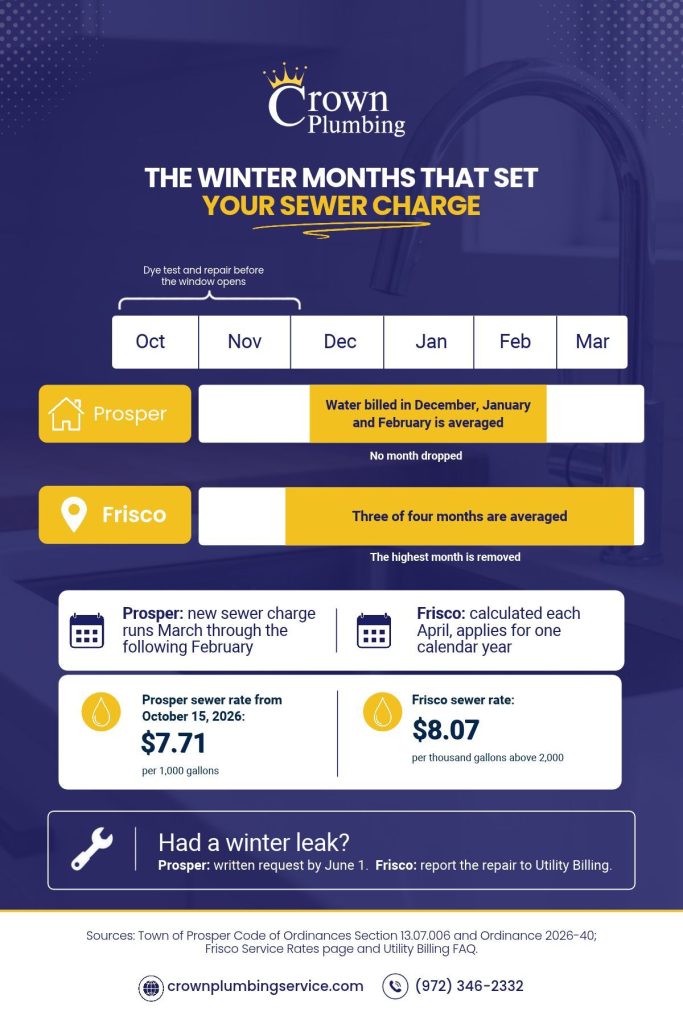
A toilet that runs through December wastes water you pay for once, and then it costs you again. In Prosper, the water billed in December, January, and February is averaged to set your sewer charge from March through the following February, so a leak you fix in January can still be sitting on your bill a year later. Frisco uses a winter window too, with different months and a different start date. The repair is usually a small one. The timing is what people miss.
TL;DR
A toilet keeps running for one of three reasons: a flapper that no longer seals, a fill valve that will not shut off, or a chain holding the flapper open. That leak is billed twice in winter, because North Texas towns set the sewer charge from winter water use. Under Section 13.07.006 of its code, Prosper averages the water billed in December, January, and February and applies that figure from March through the next February, at $7.71 per 1,000 gallons from October 15, 2026. Frisco averages three of the four months from December to March, drops the highest, and recalculates each April for one year. Run a dye test in October or November, repair what it finds, and keep the dated invoice. Prosper’s code allows a sewer adjustment request for a documented winter leak until June 1.
Why Does a Toilet That Keeps Running Cost More in Winter?
Winter is when your town measures you. Sewer service has no meter, so the utility estimates what goes down your drains from the water that comes into the house during the cold months, when the sprinklers are mostly idle. A running toilet inflates that estimate. You pay for the wasted water on the bill for the month it leaked, and then you pay a higher sewer charge every month the inflated average stays in force.
Frisco’s utility billing FAQ says it in one line: “Since sewer is not metered, the city uses the average water consumption at your home during the winter months.”
| Water charge | Sewer charge | |
|---|---|---|
| Based on | Gallons through the meter that month | Your winter average |
| A December leak shows up | On the bill for the month it leaked | On every bill until the average resets |
| Fixing the toilet ends it | Right away | Not until the next winter is counted |
The leak is easy to overlook for the same reason. A winter water bill is the smallest of the year, so nobody studies it. EPA’s Fix a Leak Week guidance suggests looking at a colder month such as January or February for exactly this purpose, and says a family of four using more than 12,000 gallons in that month may have serious leaks.
October and November: Find It Before the Window Opens
Two months of slack is plenty. A dye test takes ten minutes a toilet and needs nothing you do not already own. The steps below are the ones EPA publishes for homeowners.
- Lift the tank lid and put a few drops of food coloring in the tank water.
- Leave the toilet alone for 10 minutes. No flushing.
- Look in the bowl. Any color there means water is slipping past the flapper.
- Flush right after, so the dye does not stain the tank.
Test every toilet in the house, and start with the one that gets used least. A guest bath toilet can leak for months, because nobody is in the room to hear the tank top itself off.
What the symptom tells us
| What you notice | Usual cause | What we replace |
|---|---|---|
| The tank refills by itself now and then, with nobody near it | Flapper no longer seals | The flapper, and the flush valve seat if it is pitted |
| A steady hiss, with water standing at the top of the overflow tube | Fill valve will not shut off | The fill valve |
| It runs after a flush until someone jiggles the handle | Chain or handle is holding the flapper up | The chain, the handle, or the trip lever |
The same EPA guidance says a flapper should be checked periodically and replaced at least every five years, since the rubber wears. That matches what we see in the tank. A flapper that has gone soft or warped will not reseat, no matter how carefully the chain is adjusted.
One pattern deserves a second look. When a fill valve fails early, or fails a second time in the same toilet, we put a gauge on a hose bib before fitting another one. House pressure above the 80 psi code limit wears fill valves out ahead of schedule, and swapping the part without checking leaves the cause in place.
Water on the floor around the base is a separate problem. That points to the seal under the bowl, which will not show up in a dye test and will not wait for a convenient month. Call for that one, whatever the calendar says.
December Through February: What Prosper Does With Every Gallon
The rule is short. Section 13.07.006 of the Town of Prosper Code of Ordinances says residential sewer customers are billed on a winter water consumption average, and that “water consumption billed in December, January and February shall be averaged to calculate sewer charges beginning in March and ending in February the following year.”
Read the word billed twice, because it moves the starting line for everyone.
A December bill covers water used in the weeks before it was printed, so the window effectively opens before the first of December. The service dates on your own bill show exactly where it starts for your address.
The price went up this fall. Ordinance 2026-40, adopted by the Town Council on September 8, 2026, replaces the water and sewer section of the fee schedule in the same code. From October 15, 2026, the residential wastewater charge is $7.71 per 1,000 gallons of winter average, up from $6.54, on top of a minimum service charge of $44.72, up from $37.91.
Here is what that does to a leak, using nothing but multiplication.
| If the winter average rises by | Added sewer charge per month | Added over March to February |
|---|---|---|
| 1,000 gallons | $7.71 | $92.52 |
| 1,500 gallons | $11.57 | $138.78 |
| 3,000 gallons | $23.13 | $277.56 |
That is the price of leaving one toilet alone for a single winter.
The middle row is not picked at random. EPA says nine percent of homes have leaks that waste 50 gallons or more a day, and 50 gallons a day is about 1,500 gallons a month. A toilet leaking at that pace through all three billed months lifts the average by the full 1,500.
Compare that with the water itself. According to the same ordinance, the first 10,000 gallons of residential water are billed at $5.50 per 1,000, so three months of that leak is 4,500 gallons, or about $25 of water. The sewer consequence is more than five times the size of the water bill that caused it. One caution on the arithmetic: Prosper has reset its rates each October for the last two years, so the price per 1,000 gallons can change while your average stays put.
If you moved in this year
New accounts have no winter average yet. The same section of the Prosper code says those customers are billed for sewer on the water they use each billing cycle, capped at 10,000 gallons, until an average is established. For a new owner, a running toilet raises the sewer charge the same month. There is no delay and nothing to wait out.
Frisco Counts Four Months and Throws One Out
Frisco gets to a winter average by a different road. Frisco’s Service Rates page says the single-family sewer charge is set “by averaging the billed consumption for three of the following four months: December, January, February and March (removing the month with the highest consumption).”
That one dropped month changes the advice for a short leak, and only for a short leak.
A toilet that runs for a few weeks and gets fixed will probably land in the month Frisco throws away. A toilet that runs across two billing months will not, because only one month can be the highest.
The same page lists the residential sewer charge at $38.31 for the first 2,000 gallons and $8.07 per thousand above that, under rates effective January 1, 2026. Above the first 2,000, each extra 1,000 gallons in a Frisco winter average is $8.07 a month, or $96.84 across the year the figure applies. Because the page charges per thousand gallons “or fraction thereof,” a partial thousand rounds up.
Frisco’s utility billing FAQ adds the detail most homeowners never hear: if you filled a pool or had a leak during the winter months, report it to Utility Billing, since it “could affect your sewer rate.” Have the repair invoice in hand when you call. If the toilet still needs fixing first, that repair is part of what we handle for homeowners in Frisco.
McKinney, Celina and Little Elm Set Their Own Windows
We work in all three, and each utility writes its own sewer rule. We have only printed the rules we read on a town’s own page this month, which is why Prosper and Frisco get the detail here. The dye test and the repair do not change from town to town, and neither does the plumbing work we do in McKinney. Before December, find your utility’s rate page or call billing and ask three things:
- Which months are counted for the sewer average?
- Is any month dropped?
- On which bill does the new figure start, and how long does it stay?
March and After: When Does the Sewer Charge Reset?
In Prosper, the new average starts with the sewer charges for March and stays through February of the following year. Frisco’s FAQ says the sewer rate “is calculated each April and will apply for one calendar year.” So a leak repaired in January 2027 keeps raising a Prosper sewer charge until the bills for March 2028, and a Frisco one until April 2028, unless January was the month Frisco dropped.
| Prosper | Frisco | |
|---|---|---|
| Months counted | Water billed in December, January and February | Three of December, January, February and March |
| Month dropped | None | The highest of the four |
| New figure starts | March | April |
| Stays in force | Through the following February | One calendar year |
| After a winter leak | Written request by June 1, with documentation | Report the repaired leak to Utility Billing |
Prosper’s code leaves one door open, and it has a date on it. Section 13.07.006 says “a reasonable adjustment can be made to the sewer bill if a water leak can be documented during the winter average data collection period,” and that the request has to reach the Utility Billing Department by June 1 following that period. If the lost water cannot be calculated, the prior year’s average can be used, at the billing official’s discretion.
Do not read that section as a promise about your toilet or your bill.
Prosper’s separate credit on the water bill excludes toilets and toilet flappers by name, which we went through in which leaks Prosper will credit on the water side. The sewer section does not repeat that list, and it does not say a toilet qualifies either. Ask Utility Billing how they treat a documented toilet repair, and ask before June.
What helps is paper. Keep these three things from the day of the repair:
- An invoice with the date, the address, and the part replaced
- The meter reading, or the usage shown on the bills before and after
- A photo of the dye in the bowl, if you ran the test
Should You Rebuild the Tank or Replace the Toilet?
Rebuild it when the porcelain is sound, and the toilet already flushes on 1.28 gallons or less. Replace it when the tank or bowl is cracked, or when an older, thirstier toilet is on its second or third repair. Flush volume belongs in the decision because every winter flush is in the sewer average too.
State law draws the line for you. Texas Health and Safety Code Section 372.002 caps a toilet sold in Texas on or after January 1, 2014 at an average of 1.28 gallons per flush. Under the same section, toilets sold before that date were held to 1.6 gallons. So a replacement bought today for an ordinary home bathroom will be a 1.28-gallon model, whatever an older brochure says.
The EPA WaterSense page on residential toilets puts 1.28 gallons at 20 percent less water than the federal standard of 1.6, and says older toilets can use as much as 6 gallons per flush. It also says toilets account for nearly 30 percent of an average home’s indoor water use. That share is why the flush volume moves a winter average more than any other fixture in the house.
| The toilet in front of us | Flush volume | Our usual call |
|---|---|---|
| Sold in Texas since 2014 | 1.28 gallons or less | Rebuild the tank parts |
| Sold before 2014, marked 1.6 | 1.6 gallons | Rebuild if the porcelain is sound, and it clears the bowl in one flush |
| Sold before 2014, on its second or third repair | 1.6 gallons | Price both, and lean toward replacing |
| Older, with no 1.6 marking | As much as 6 gallons, per EPA | Replace |
| Any age, with a cracked tank or bowl | Any | Replace |
The marking is usually stamped on the bowl behind the seat hinges, or printed inside the tank. If you cannot find one, the date stamped in the tank is the next best clue.
We can repair almost any toilet as long as the porcelain is in good shape. When the table points the other way, we handle the swap as well, and both jobs sit under toilet repair and replacement. If you want a sense of the numbers first, our guide to fair plumbing prices in DFW lists the market range for a flapper or fill valve swap, a full rebuild, and a replacement.
Dye Test Every Toilet Before the December Bill
Pick a weekend in October or November. Put food coloring in every tank, wait ten minutes, and look. If a bowl shows color, or you can hear a tank refilling with nobody in the room, you have until the first winter bill to fix it before it counts toward the sewer average.
After that date, the repair still stops the waste, and the invoice becomes the thing to hold on to. Prosper customers have until June 1 to ask about a sewer adjustment. Frisco customers should report the repaired leak before the April calculation.
If the test finds something, call Crown Plumbing. We are based in Prosper and work across Frisco, McKinney, Celina, and Little Elm. Tell us what the dye did and which toilet it was, and we will put the date, the fixture, and the part on the invoice so your utility has what it asks for.

